650 Strikes in Iraqi Kurdistan: How deniability became a weapon


Shafaq News
Since the outbreak of hostilities between the United States, Israel, and Iran on February 28, 2026, the Kurdistan Region of Iraq has absorbed approximately 650 missiles and drone strikes, killing 16 people and wounding roughly 100 others. Legal analysts and regional experts increasingly argue that the near-total absence of claimed responsibility is not a byproduct of regional chaos —it is the strategy.
The drone that struck Kurdistan Region President Nechirvan Barzani's residence in Duhok on March 28 bore no flag. No faction claimed it; no official investigation acknowledged it. That silence is consistent with every other major incident in a campaign documented by Shafaq News across all four provinces of the Kurdistan Region through Tuesday, April 7, at 10:00 a.m. —documentation that came at a cost. KRG authorities imposed media restrictions on strike sites, prohibiting photography in the immediate aftermath of attacks, and many incidents were recorded not from the strikes themselves but from the debris they left behind.
Of 652 total drone and missile strikes recorded since February 28, nearly 80 percent targeted Erbil alone. Al-Sulaymaniyah absorbed 106, Duhok 25, Halabja 2, and Raparin 1. Geographic concentration of this specificity points to a hierarchy of targets, which is precisely what international law requires investigators to establish when building a war crimes case.
Christian Peacemaker Teams, a monitoring organization with field personnel embedded across the Region, documented 474 attacks through April 5, recording 14 killed, 93 wounded. Erbil's Governor Omed Khoshnaw has separately confirmed that his province alone has faced more than 500 drone strikes since February 28.
Read more: Drone attack on Nechirvan Barzani: Message at the peacemaker’s door
According to CPT's breakdown, the Iranian Revolutionary Guard Corps directly executed 179 of the documented attacks, while 295 were carried out by Iran-aligned armed factions operating inside Iraq, groups that occupy the legal grey zone between state proxy and independent actor, a distinction carefully cultivated over years of Iranian influence architecture in the country.
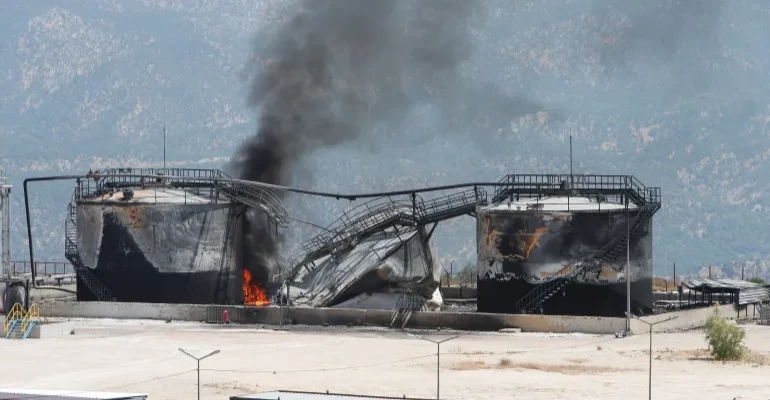
The claiming pattern is itself the architecture. Iran has acknowledged strikes on Iranian Kurdish opposition sites; affiliated factions have claimed attacks on US-linked targets. Yet both Iran and those factions have denied any involvement in the strike on President Barzani's residence in Duhok and publicly condemned it, and Barzani himself noted that Iran struck a Peshmerga headquarters in Erbil by mistake. Attacks on oil fields and civilian infrastructure remain in a separate category of contested ambiguity. What gets owned and what gets disowned tracks precisely with legal and diplomatic exposure: responsibility is asserted where it signals deterrence, and withdrawn where it would trigger accountability.
Political analyst Hussein al-Kanani situates the campaign within the broader regional conflict, arguing that the US use of Iraqi airspace to strike Iran has generated reactive strikes from multiple directions. Speaking to Shafaq News, he considers military base strikes "foreseeable" within that logic, while drawing a sharper line at consulates, oil fields, and civilian structures, targets he describes as unjustified, and potentially exploited by third parties seeking to implicate Iranian-aligned factions. Whether or not that reading holds, it names the precise mechanism international lawyers flag as the campaign's central legal obstacle: what is known in international law as plausible deniability —the deliberate use of front names, unknown media facades, and absent official claims to sever the evidentiary link between perpetrator and act.
Read more: Iraq's air defense: US vetoes, Russian limits leave Baghdad exposed
The casualty profile strains that ambiguity considerably. Among the 16 dead are six Peshmerga from the Kurdistan Region's First Region Command in the Khalifan area, one Asayish security officer killed at Erbil International Airport, six Peshmerga affiliated with Iranian Kurdish opposition parties across Erbil, Sulaymaniyah, and Baashiqa, two civilians, and one French soldier, killed in Erbil on March 12. This reflects specific strategic interests: suppressing Iranian Kurdish opposition movements, degrading Kurdistan Region security infrastructure, and applying pressure on Western military presence without triggering a formal state-level response. The precision of the victim profile is itself evidence against randomness.
International legal experts note that repeated patterns in targets, tactics, and weaponry can constitute circumstantial evidence sufficient to anchor an international investigation even without direct attribution. The principle of command responsibility, which holds senior military and political figures liable for crimes committed by forces under their effective control, regardless of whether explicit orders were issued, means that the absence of claimed responsibility only lengthens the chain of legal accountability.
The legal framework is substantial, if as yet untested: the strikes violate the principle of distinction enshrined in the Geneva Conventions, which prohibits targeting civilian persons and objects. The assault on the US consulate breaches the Vienna Convention on Consular Relations. The use of imprecise weaponry in populated areas constitutes an indiscriminate attack under Article 51 of the First Additional Protocol. None of these violations is subject to statutes of limitation.
Iraqi Foreign Minister Fuad Hussein described the strike on Barzani's residence as "a serious indication of the consequences of failing to take firm measures in response to previous attacks," a statement that functions as much as an indictment of Baghdad's prior inaction as a condemnation of the strike itself.
Political analyst Kazem Al-Yawar argues that what is unfolding exceeds scattered security breaches. Speaking to Shafaq News, he describes the strikes as targeting "all vital joints" of the Region —energy infrastructure, airports, military sites, and civilian residential buildings— a breadth of targeting that, in his assessment, reflects deliberate strategic logic rather than operational spillover. Responsibility for protecting Iraqi sovereignty, Al-Yawar states, rests with the federal government, making effective coordination between Baghdad and Erbil, particularly along the Iranian and Turkish borders, not a political preference but a constitutional obligation the current campaign has exposed as unmet.
He also characterizes the attacks as "a clear and flagrant violation of Iraqi sovereignty, UN principles, and international law," noting that Iraq holds the legal standing to file complaints before the UN Security Council and pursue compensation claims for documented damages —an avenue the parallel legal tracks now underway in Baghdad and Erbil appear designed to activate.
Read more: Between war and neutrality: Kurdistan navigates US-Iran confrontation
Legal expert Mohammed Jumaa has argued that strikes on the Kurdistan Region are classifiable as terrorist acts under Iraqi anti-terror legislation. "The law focuses on the nature and impact of the act, particularly when it spreads fear or targets civilian environments, rather than solely on the identity of the perpetrator."
Shafaq News has learned that Iraqi authorities and the Kurdistan Regional Government are pursuing three parallel legal and diplomatic tracks: forensic documentation through analysis of recovered drone debris, formal complaints to the UN Security Council, and legal classification of perpetrators as terrorist entities with an emphasis on command responsibility. Physical evidence recovered from strike sites can establish weapons provenance in ways that override claimed or disclaimed responsibility, the point at which the fog of deliberate ambiguity begins to lift.
Read more: Iraq’s neutrality fades: Formal war involvement draws closer?
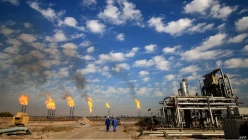
Political analyst Ali Al-Baidar links the strikes on oil infrastructure to consequences that extend well beyond the security domain. He explained to Shafaq News that attacking the energy facilities, that represent vital infrastructure on which economic and livelihood stability depends, “disrupts services, deepens crises, and directly threatens the safety of civilians and workers,” placing the attacks in tension with the international humanitarian law principles of distinction, proportionality, and precaution, all of which obligate parties to a conflict to avoid strikes of this kind.
Al-Baidar is nonetheless precise about the limits of current analysis: "final legal characterization remains contingent on investigation" —a reminder that evidentiary clarity must precede legal judgment, however strong the circumstantial case.
The killing of a French soldier in Erbil has received less international attention than its diplomatic weight warrants. France maintains military personnel in Iraq as part of the Global Coalition; an attack that kills a coalition soldier is an attack on that coalition's operational presence and its tolerance for ambiguity. That no government has formally attributed the March 12 strike, and that no serious diplomatic rupture followed, reflects how thoroughly the deniability architecture has been absorbed into international calculus.
The Kurdistan Region is the terrain on which a specific legal and political gamble is being tested: that sustained ambiguity can insulate the authors of a systematic campaign from the consequences international law was designed to impose. The forensic documentation underway, the UN complaints being prepared, and the debris being catalogued in Duhok and Erbil constitute the counter-argument —that patterns speak when perpetrators will not.
Whether international institutions prove willing to hear them is what this campaign will ultimately answer.
Read more: US-Iraq security agreements keep failing: Baghdad’s sovereignty deficit
Written and edited by Shafaq News staff.