The New era of control: Can Iraq's free press survive its politically-tainted rulers?


Shafaq News
Iraq enters 2026 under a new parliament shaped by dominant political blocs, and the country confronts a critical test: whether the next four years will bring meaningful protection for journalists or a tightening of long-standing political and legal pressures.
International indicators offer a deceptive snapshot of progress. The 2025 Reporters Without Borders index places Iraq at 155th worldwide—an improvement from 169 in 2024 and 172 in 2023—yet these numbers mask a more troubling reality visible on the ground. Over 340 journalists have been killed across three decades, according to the Strategic Center for Human Rights, whose head, Fadel Al-Gharawi, underscored that Iraq remains one of the world’s most dangerous environments for media workers.
The contradiction between global rankings and daily risks sets the stage for a deeper question: how will the political winners of the 2025 elections influence the future of journalism in Iraq, given their historical patterns of restricting media freedoms?
Lawsuits Are Power
Understanding the implications for journalists requires examining the trajectory of the political forces that secured the largest gains in the latest elections. The Reconstruction and Development bloc (Al-Ima'ar Wal Tanmiya), led by caretaker Prime Minister Mohammed Shia Al-Sudani, emerged with the strongest parliamentary presence. But this rise comes with a documented record of legal pressure on the media.
Over the past three years, Al-Sudani filed 11 personal lawsuits against journalists and commentators, while government bodies filed dozens more. Violations in 2024 alone exceeded 460 cases—higher even than the turbulent years following the 2019 protests—and included actions such as blocking prominent outlets like Ultra Iraq.
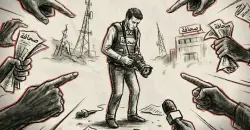
Speaking on condition of anonymity, an independent Baghdad journalist told Shafaq News, how pressure extends beyond the courtroom, explaining that political actors influence digital platforms, exert pressure on media institutions, and create an environment where journalism becomes a daily risk.
The State of Law coalition (E’tilaf Dawlat Al-Qanoun), led by former PM Nouri Al-Maliki, also maintains a long-standing reputation for restricting the press. Al-Maliki filed six lawsuits against journalists during his tenure, while overall violations between 2005 and 2014 surpassed 2,000 documented cases, ranging from raids and forced closures to physical assaults.
In just the last two years of his premiership, more than 500 incidents were recorded. A defining moment came in April 2013, when ten satellite channels were shut down simultaneously following the Hawija events—a decisive demonstration of the state’s willingness to impose coordinated censorship.
At the provincial level, similar patterns emerged. In Al-Anbar, the Progress (Taqaddum) Party, headed by former parliament speaker Mohammed Al-Halbousi, leveraged its influence to shape public narrative, most notably when school principal and poet Ahmed Zakrut was relocated after reciting a poem criticizing public services in 2021.
In 2019, activist Samir Faraj was arrested for expressing political views, while journalists investigating corruption or administrative failures faced threats.
In the Kurdistan Region, media workers who exposed corruption or political dominance were sometimes accused of espionage or detained under expansive security laws. Parties such as the Sadiqoon Movement and Badr Organization were also repeatedly linked to intimidation against journalists probing misconduct or criticizing officials.
The sum of these examples illustrates a nationwide pattern that political power has routinely translated into pressure on journalists.
Read more: Iraq's vague Protest Law: A tool for control or a framework for rights?
Morals, Not Rights
Despite constitutional guarantees protecting freedom of expression and peaceful assembly, Iraq’s legal system continues to rely on restrictive provisions, particularly those within the 1969 Penal Code.
Broad terms such as “public morals” and “public order” remain frequently invoked to intimidate journalists, while proposed amendments threaten to impose severe penalties—including life sentences—for online content deemed harmful to unity, economic interests, or national security. These vaguely defined categories create fertile ground for selective prosecution, reinforcing self-censorship as a survival strategy.
A pivotal development occurred in August 2025, when this parliament—whose term concluded on November 11—revived a contentious draft law that had stalled since 2023. The original bill was titled the Law on Freedom of Expression, Assembly, and Peaceful Demonstration. But in its revived form, all references to “freedom of expression” and the “right to knowledge” were removed from both the title and its articles.
Legal experts view this omission as a deliberate narrowing of the bill’s purpose, excluding protections that once formed the core of the legislation.
Although the draft includes a clause allowing journalists to cover demonstrations freely and seek compensation for physical or material harm, legal specialists argue that such guarantees are overshadowed by deeper structural concerns.
Speaking to Shafaq News, legal expert Ali al-Tamimi stressed that the draft contains at least 17 fundamental legal flaws, requiring complete reconstruction. He further pointed to Article 38 of the Iraqi constitution, which guarantees freedom of expression and peaceful assembly—protections that, in his view, the current draft undermines rather than upholds.
Moreover, political analyst Mujashaa al-Tamimi warned that vague terms like “public order” and “morality” could easily be weaponized to suppress dissent, cautioning that, without strong safeguards, such language becomes a tool to silence citizens rather than protect them.
Truth Goes Informal
Simultaneously, debate over the pending Right to Information Law has become a focal point of concern. The Strategic Center for Human Rights warned that the expected amendments may sharply restrict journalists’ access to official documents—changes that would push reporters toward informal channels, complicate verification, heighten legal exposure, and make investigative work increasingly perilous.
These legal uncertainties intersect with the broader realities of Iraq’s media economy. Politically affiliated outlets operate with steady funding and institutional protection, while independent platforms face chronic financial instability, limited advertising opportunities, and recurring closures. This imbalance leaves independent journalism structurally vulnerable at the exact moment when scrutiny of public institutions is most needed.
Digital media initially seemed to counter these constraints by expanding the space for alternative voices, yet it now confronts sustained monitoring and political pressure. Content judged offensive to national or religious symbols is routinely removed, and reporters covering corruption or political influence endure cyberattacks, threats, abduction attempts, and physical assault.
The Al-Nakheel Center for Rights and Press Freedoms captured the daily atmosphere: fear not only of lawsuits but of anonymous messages and direct pressure on media institutions—pressures felt most acutely by younger journalists lacking institutional protection.
Regional indicators further illuminate Iraq’s uneasy position. Tunisia ranks 118, followed by Morocco at 129, Lebanon 130, Kuwait 131, Jordan 132, and Oman 137. The UAE stands at 160, Saudi Arabia 166, Egypt 170, Bahrain 173, and Syria 179.
Lebanon, despite its political volatility, sustains comparatively broader room for independent media through stronger institutional safeguards. Gulf States, by contrast, employ highly structured legal and security controls.
Iraq sits uncomfortably between the two models—exposed to legal and security pressures yet without robust institutions capable of shielding journalists. This combination helps explain why modest improvements in international rankings have not translated into genuine safety.
Read more: The Fine Print of Freedom: Iraq to amend Freedom of Expression and Peaceful Assembly Law
Written and edited by Shafaq News staff.