Israel's secret base in Iraq: what happened in the western desert and why Baghdad couldn't respond


Shafaq News
An Israeli airstrip, a dead soldier, and a Wall Street Journal scoop —how a secret base in Iraq's western desert exposed the gap between Baghdad's sovereign claims and the foreign militaries that treat them as optional.
Iraqi sovereignty is a legal claim the state asserts, and foreign militaries treat as optional, and the western desert between Najaf and Karbala is where that gap between claim and reality became, in February and March 2026, a matter of satellite coordinates, a dead soldier, and a Wall Street Journal scoop that Baghdad spent two months not providing itself.
A foreign military built an airstrip on Iraqi soil, used it to wage war on a neighboring country, fired on Iraqi troops who came to investigate, and left having calculated, correctly, that Iraq would absorb the violation rather than confront it.
Baghdad's answer was to launch a military operation afterward called "Impose Sovereignty" —the name alone a precise admission that sovereignty, in this territory, was something that had to be reclaimed rather than something that had been present.
The Satellite Doesn't Lie
The physical record is not seriously in dispute, and it begins with a shepherd. On March 4, a local herder in the remote desert southwest of Najaf and Karbala reported unusual helicopter activity to military authorities in Najaf. Iraqi forces were dispatched. They came under fire from the air. One soldier was killed, and two were wounded. Baghdad submitted a protest note to the Global Coalition without naming who had fired, and the incident was quietly classified —until the Wall Street Journal named the party responsible on May 9.
The WSJ, quoting US officials and other sources, reported that Israel established a secret makeshift base in Iraq's western desert shortly before the war began on February 28, using it as a forward logistics hub for the Israeli Air Force, a staging point for special forces, and a rescue station for pilots downed over Iran. When Iraqi troops approached the site in early March, Israel launched airstrikes to protect it. The US knew the base existed, the report said, and was not involved in the strikes.
The satellite record corroborates the account; Copernicus Sentinel-2 imagery dated March 8, 2026, shows a straight, graded temporary airstrip approximately 1.6 kilometers long, carved into a dry lakebed at coordinates 31.66777°N, 42.44849°E —roughly 180 kilometers southwest of Najaf and Karbala, matching the WSJ's description both geographically and chronologically. The western desert of Iraq, experts told the WSJ, is near-perfect terrain for a clandestine military outpost —sparse population, vast and featureless, beyond the reach of routine surveillance. The site's flat, hard surface allowed rapid construction and short-field operations for helicopters, though rain flooding the dry lake bed almost certainly rendered it inoperable by mid-March.
The Israeli Air Force chief had offered a hint in public. In March, Major General Tomer Bar said special forces had been conducting "extraordinary missions that can spark one's imagination" during the Iran campaign, without elaborating. Open-source intelligence analysts, working from the same satellite archive, identified the airstrip within 48 hours of the WSJ publication, placing it, with precision, in the exact location the report described.
Baghdad has treated the base's temporary nature as the operative fact. It is the least relevant one. A sovereign state's territory was used for combat operations without consent, and the force using it fired on that state's soldiers to preserve the secret. Whether the airstrip remained operational for days or weeks changes none of that.
Denial as Policy
Iraq’s Joint Operations Command denied the presence of any unauthorized forces after extensive search operations. The Security Media Cell confirmed that Iraqi forces clashed with unknown detachments backed by air cover on March 5, while insisting nothing was found afterward.
Karbala Operations Commander Ali al-Hashemi acknowledged an Israeli force had been present inside Iraqi territory, adding it did not remain for more than 48 hours.
The Defense Ministry's media director said the force carried American weapons, denied it had established a base, and described its presence as lasting only hours.
The head of the Security Media Cell, Lieutenant General Saad Maan, said during a field tour of the Nukhaib desert that “any presence had been temporary” and that the rapid deployment of Iraqi forces had ended it, while denying that a permanent military base had ever existed.
The statements appeared increasingly contradictory as the week progressed, each clarification introducing a new detail that complicated the previous denial.
Military expert Brigadier General Jawad al-Dahlaki, speaking to Shafaq News, offered the formulation the official narrative had been building toward: what occurred was “military simulation activity, not a permanent base,” and the forces departed after their location was compromised. Security expert Mukhalad Hazem al-Darb, also speaking to Shafaq News, noted that the terrain suits temporary covert operations and that discovery typically ends such presences quickly.
Both framings are calibrated to minimize rather than address the violation they are describing —and both collapse against the detail neither has refuted: an Iraqi security source told al-Arabiya that the American side informed Iraqi forces of the need “not to approach the area for security reasons,” a claim reported identically by Iraqi and Saudi media. Neither Baghdad nor Washington has denied it. If accurate, the United States —Iraq's strategic partner under the 2011 Framework Agreement—actively instructed Iraqi forces to stand down from investigating a foreign military installation operating illegally on their own soil.
Images circulating on social media claimed to show the facility, adding noise to an already contested picture. The Misbar fact-checking team concluded they were AI-generated, with content analysis tools assessing the probability of fabrication at above 98% —citing visual inconsistencies including a mismatch between the number of helicopters shown and the accompanying text, and geographic coordinates that did not correspond to recent satellite imagery of the alleged site. The fabricated images did not discredit the underlying story —the satellite record, the WSJ sourcing, and Baghdad's own admissions of a clash are independently verifiable. Their function was to make facts harder to establish, leaving a residue of uncertainty that benefits those who prefer the story unresolved, which in the current political climate is almost everyone with a stake in Baghdad's stability.
Agreement That Changed Nothing
The 2011 US-Iraq Strategic Framework Agreement exists precisely to prevent what happened in the Najaf-Karbala desert. It governs military movement, prohibits unauthorized operations inside Iraqi territory and airspace, and commits Washington to Iraq's security and sovereignty. Al-Dahlaki told Shafaq News directly that the incident constitutes a “breach of that agreement.” It is not the first breach Baghdad has documented and failed to address.
In October 2024, Baghdad submitted a formal protest to the UN Security Council after Israeli jets used Iraqi airspace to strike Iran, instructing the foreign ministry to communicate with Washington about its obligations under the bilateral agreement. The protest produced no change in behavior and no public American response. The desert base is the same pattern at higher intensity: unauthorized use of Iraqi territory, this time with a ground presence, Iraqi casualties, American knowledge confirmed by the WSJ's own sourcing, and the same enforceable consequence, which is none.
Former Prime Minister Mustafa al-Kadhimi wrote on X that "if the reports are true, we are faced with a grave breach that undermines Iraq's sovereignty, necessitating full transparency and a clear assignment of responsibilities."
To say it is true is to say the 2011 agreement is decorative and Iraq's sovereignty is a legal concept that foreign militaries treat as optional. To say it might not be true preserves the concept while the evidence contradicts it.
The incident arrives as Baghdad seeks to respond to US pressure to disarm Iran-backed armed groups while managing the formation of a new government under prime minister-designate Ali al-Zaidi, a government that has received congratulations from both Washington and Tehran and cannot afford to antagonize either.
Badr bloc parliamentary representative Shakir Abu Turab al-Tamimi told Shafaq News that a US-Israeli presence remains active in western Iraq and that Iraqi forces have been prevented from approaching it, a claim the official security apparatus flatly denies.
The contradiction places the government in an impossible position: it must simultaneously reject the allegation and manage its relationship with the party the allegation is directed at, an arrangement that can be sustained indefinitely, but only at the cost of the sovereign credibility it continues to insist it holds.
Security analyst Adnan al-Kinani, speaking to Shafaq News, argued that international coverage amplifies the hypothesis of Israeli military activity in Iraqi territory as deterrence messaging. The story was published when someone decided the time had come for it to be known. The Israeli i24News assessed the WSJ publication as a deliberate strategic reveal, timed to signal Israeli operational reach across 1,600 kilometers of hostile territory to multiple audiences simultaneously. The story's content is no less accurate for its timing being calculated. What the reveal signals —to Tehran, to Baghdad, to every regional actor watching— is that Israeli operational reach extends into Iraqi territory regardless of what Iraqi law says, and that the United States is aware of and complicit in that reach. That signal, delivered through a newspaper, is itself an exercise of the sovereignty Iraq does not have.
The Desert Is Still Open
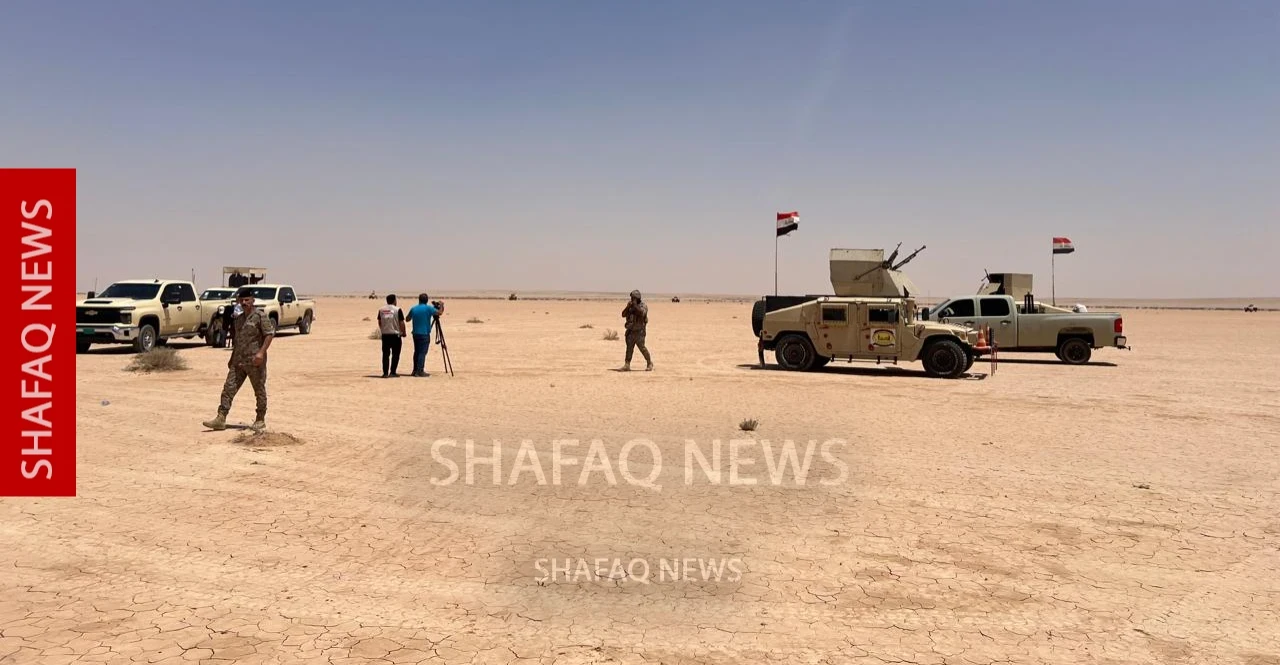
Iraq's army chief of staff visited the area to show the country can secure its own desert, the unstated acknowledgment being that a secret Israeli base had just operated there. The Popular Mobilization Forces (PMF) operation that followed, moving along four axes to a depth of 70 kilometers under direct military supervision, is a demonstration of presence rather than an exercise of the control that presence is meant to project.
Both gestures —the visit and the operation— are addressed to a domestic audience that can read the satellite images, follow the Wall Street Journal, and draw its own conclusions. They are not addressed to the parties whose behavior they are designed to deter, because Baghdad has no instrument of deterrence it can credibly deploy against them.
Iraq's western desert has been a permeable space for years —to smuggling networks, armed factions crossing from and to Syria, and now confirmed foreign military installations “operating with American knowledge and defended with Israeli airstrikes against Iraqi forces.” The 2011 agreement, the Impose Sovereignty operation, and the formal UN protests did not close that permeability.
What determines whether foreign militaries use Iraqi territory is not Iraqi law or Iraqi protests —it is whether those militaries calculate that the cost exceeds the benefit. In February and March 2026, Israel made that calculation and acted on it. The airstrip is gone, but the desert is still open, the agreement is still unenforceable, and the next force that needs a staging point in a remote stretch of terrain between two Iraqi provinces will make the same calculation, reach the same conclusion, and find the same answer waiting.
The shepherd saw what he saw. The soldier died while investigating it. And the state that sent him is still conducting search operations for something it has officially concluded was never there —sovereignty performed in the one place it was most visibly, and most lethally absent.
Written and edited by Shafaq News Staff.