Exclusive: Washington unveils ‘Iraq playbook’ under Trump’s ‘America First’ vision


Shafaq News – Baghdad
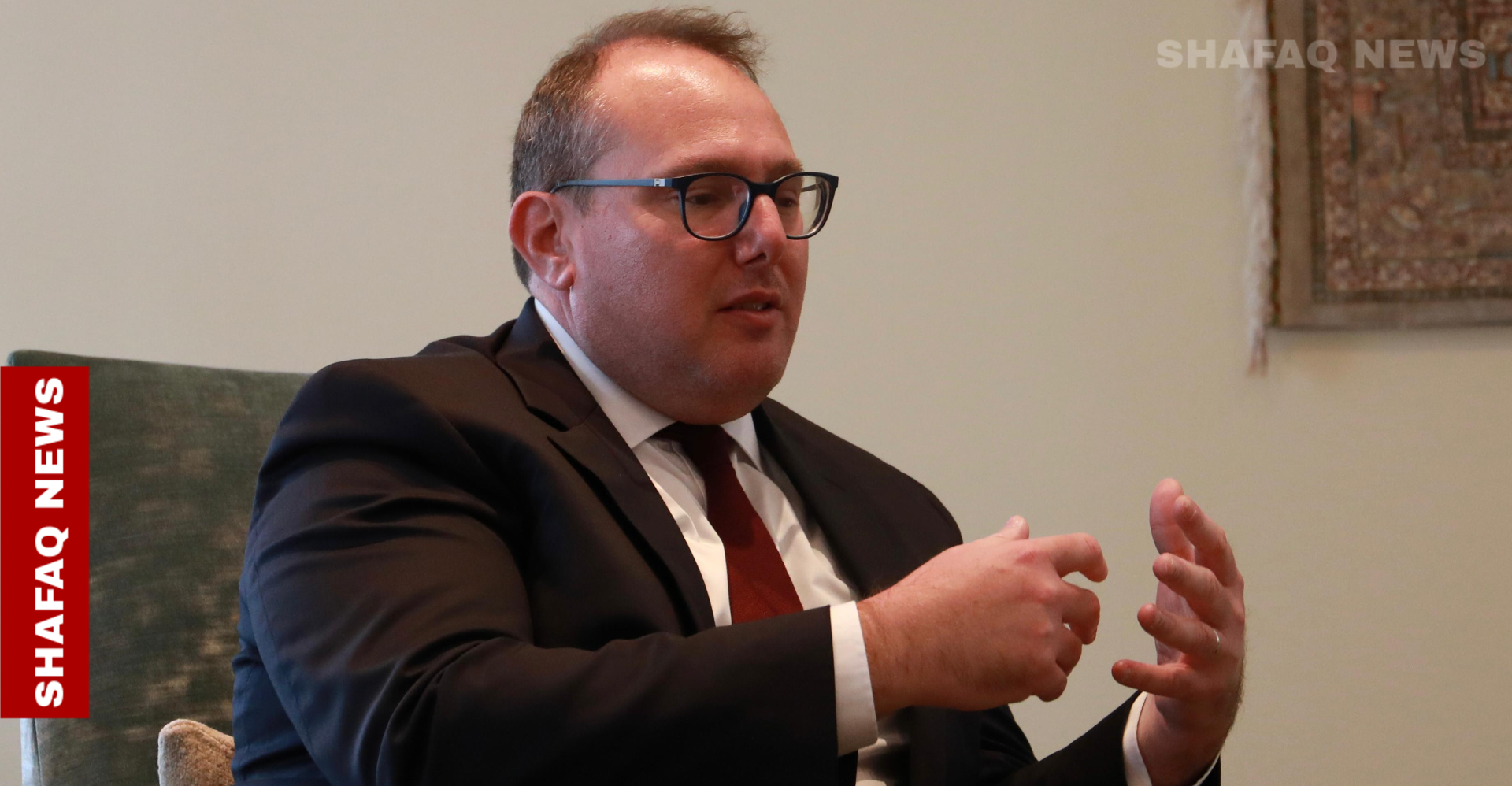
The United States Chargé d’Affaires in Baghdad, Joshua Harris, said Iraq remains central to Washington’s strategy in the Middle East, outlining priorities in security, sovereignty, economic development, and political stability.
In an exclusive interview with Shafaq News, Harris stressed that the Trump administration’s “America First” policy is being applied in a way that also seeks to build a balanced partnership with Baghdad.
Hostage Release and “Peace through Strength”
Harris opened by addressing the release of Elizabeth Tsurkov, an Israeli-Russian researcher kidnapped in Baghdad in 2023. He praised Prime Minister Mohammed Shia al-Sudani’s role in securing her freedom.
He described Tsurkov’s abduction as “a crime and a violation of Iraqi law,” stressing that Washington had been assured by Iraqi officials that her release involved “no money and no deals.”
“It’s wonderful that she has been released and reunited with her family,” Harris said, adding that the kidnapping of a US resident violated Iraqi law and that “there needs to be accountability for this crime.”
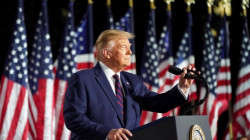
He underscored President Donald Trump’s position that “hostages need to be released, full stop,” calling the outcome an example of “peace through strength.”
Tsurkov, accused by her kidnappers of spying for Israel, was abducted in Baghdad’s Karrada district in March 2023. A video later showed her speaking in Hebrew under duress. Her captivity lasted more than 900 days before she was freed in September 2025.
“This crime never should have happened in the first place, and Iraq’s laws should be upheld in this regard,” Harris added.
Iraq’s Place in US Foreign Policy
Harris rejected suggestions that Iraq has slipped to the margins of US policy. “The United States under President Trump’s leadership is going to put American interests first. That is true of our relationship here, and it’s true for what we’re doing around the world,” he said, highlighting the work of a “wonderful team of professionals” at the US mission in Baghdad, tasked with ensuring America is “safer, stronger, and more prosperous” through “a relationship and partnership between the United States and Iraq that meets the needs of Iraq, but meets the needs of the United States, as well. That’s what we’re here to do.”
According to Harris, Washington’s vision is to support Iraq in becoming “fully sovereign, secure within its borders, and able to contribute to regional stability,” while advancing prosperity through economic growth. “And then Iraq is prosperous, it’s able to move forward in our economic relationship in a way that has real benefits, benefits of course for the people of Iraq and for the American people, as well.”
Since 2003, US policy toward Iraq has shifted under successive administrations. The Bush administration oversaw the invasion, Obama ordered a full withdrawal in 2011, Biden limited the role to training in 2021, and Trump is now pursuing a partnership rooted in sovereignty and security.
Security Partnership After Global Coalition Withdrawal
With the Global Coalition’s combat forces departing Iraq, Harris described the US–Iraqi security partnership as entering a “new chapter.” He said both countries remain committed to ensuring terrorism is “sustainably defeated” and praised Iraq’s role as a founding member of the coalition against ISIS.
“The Iraq of 2025 is a very different place,” Harris noted. “We need together to make sure terrorism is sustainably defeated. This is absolutely in the interest of the United States, and I know it is in the interest of Iraq, as well.”
He confirmed that discussions are underway on the “next chapter” of cooperation, stressing that any arrangement must meet the needs of both sides.
“We are implementing an agreed-upon transition plan that will allow this partnership to move forward to respond to the current challenges of the world that we face together. Iraq is a founding member of the global coalition to defeat Daesh, along with the United States, and we are maturing our relationship together to make sure that we have the posture and the partnership and the tools that we need to make sure that terrorism in this region is sustainably defeated. Very significant progress has been made in this regard.”
Harris declined to say whether Baghdad had formally requested US forces to remain, saying that was for the Iraqi government to state publicly.
PMF Law and Iranian-backed Groups
On the postponed draft law concerning the Popular Mobilization Forces (PMF), Harris avoided speculation about legislative outcomes but reiterated US concerns about Iran’s influence.
“One of Iraq’s neighbors [Iran] is continuing to disregard Iraqi sovereignty and, through proxy groups, drag Iraq in a dangerous direction,” he said. “The presence of Iranian-backed militia groups is a liability for Iraq’s own sovereignty, and they are a liability for an effective and strong US partnership with Iraq.”
“We will continue to speak very clearly about our concerns, the presence of Iranian-backed militia, terrorist groups that are operating in this country outside the command and control of Iraq’s government,” he pointed out, adding, “It should not be controversial that all security actors within Iraq would operate under the command and control of Iraq’s elected government.”
He noted that Washington had recently designated four Iraqi groups “that are directed and controlled by Iran,” as foreign terrorist organizations, for threatening the United States.
Kurdistan Region Relations and Oil Exports
Harris also addressed disputes between Baghdad and Erbil, including salary delays and oil exports, confirming that Washington is facilitating talks to reopen the Iraq–Turkiye pipeline.
“Progress in this regard would be very significant for US companies operating here,” he said, adding that it would also send a positive signal to investors.
During a recent visit to Erbil, Harris met Prime Minister Masrour Barzani and other officials to discuss what he described as a “very special partnership” between the US and the Kurdistan Region.
On unrest in Al-Sulaymaniyah following the arrest of former PUK co-leader Lahur Sheikh Jangi under counterterrorism charges, Harris said Kurdish officials are best positioned to speak about their own political situation. “They know their political situation; they are best positioned to speak to issues like this. We are going to continue to talk to our partners in the Kurdistan Regional Government about what matters for the United States and our shared priorities.”
“Violence anywhere in this country is very troubling and concerning,” he added. “We very much want to see a strong Iraqi-Kurdistan region, a strong Iraq that is able to partner with the United States to advance our shared priorities.”
Elections and Political Participation
On the parliamentary elections scheduled for November 2025, Harris said decisions about participation, including by Muqtada al-Sadr’s movement, are for Iraqis to make.
“The Iraqi people need to speak to their expectations about their political future,” he said. For Washington, the partnership with Iraq is “a very special partnership that has to meet our mutual needs. That’s true now; it will be true after the elections. We’re going to continue to talk about what’s – what we need to see to make a strong partnership possible.”
Israeli Strikes and Regional Tensions
Addressing allegations that Israel may launch attacks inside Iraq, Harris said he heard “very clearly” from Iraqi officials that they want to avoid being drawn into regional conflict, praising Prime Minister al-Sudani’s role in keeping Iraq out of the June 2025 12-day war between Israel and Iran.
“For Iraq to avoid entanglement,” Harris said, “there are actions that could be taken now and in the future,” particularly addressing “militia terrorist groups supported by Iran.”
“I’m not going to speculate about the future, but I will say that for Iraq to stay out of conflict, I believe that our Iraqi partners know very well there are actions that could be taken on the part of the Iraqi Government now and in the future that would make it more or less likely that Iraq would find itself in conflict. So I think it’s very important to our conversations to make sure that we’re prioritizing and seeing Iraq prioritize those actions that are going to keep Iraq out of conflict within this region … that means to address the very serious challenge of those militia terrorist groups that are supported by Iran that are working against Iraqi sovereignty and against a strong partnership with the United States. And we’ll continue to have exactly that conversation. Our Iraqi partners, I think, understand very clearly what is necessary within this period.”
Freedom of Press
Asked about freedom of expression, Harris said he valued the opportunity to engage with Iraqi media. “This is a very healthy and positive exercise,” he noted, stressing that dialogue helps explain US priorities and builds transparency in the relationship.
In closing, Harris said Iraq and the United States face “a very significant moment” in which risks are high but opportunities remain for a stronger partnership. “We want to see an Iraq that can build a future that is sovereign and secure and prosperous, exactly as what I’ve heard Iraqis expect,” he said.
Harris said that shared priorities between Iraq, including the Kurdistan Region, and the US is “making sure that Iraq’s sovereignty is defended, making sure that this country is secure within its borders and able to export security to the region, making sure that we’re doing everything possible to advance prosperity for our people, to deliver for Iraqis and Americans alike.”
Written and edited by Shafaq News staff.