Record storm leaves trail of death and destruction across Kurdistan


Shafaq News – Erbil (Updated at 12:26)
A powerful winter storm that struck the Kurdistan Region between December 8 and 10 has left a widening trail of casualties and destruction, with authorities confirming a child’s death, dozens of rescues, and severe damage to homes, shops, and infrastructure across Al-Sulaymaniyah, Halabja, Garmian, and Raparin.
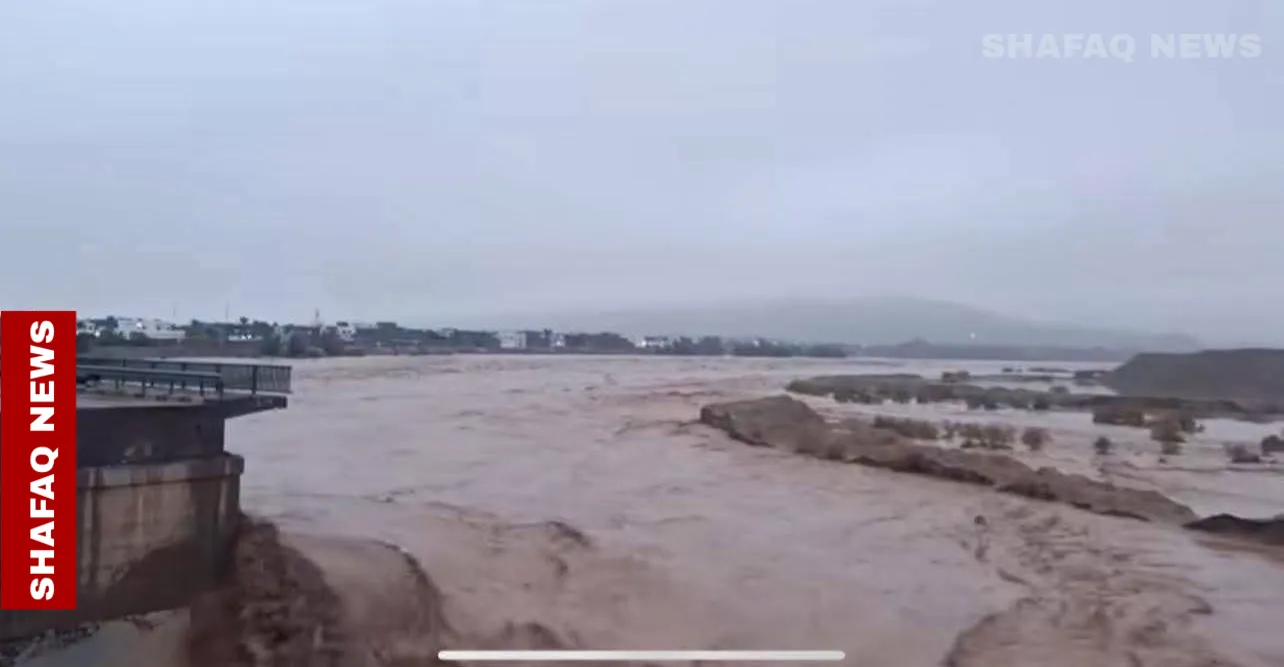
The three-day weather system delivered rainfall levels not recorded in years, triggering deadly flash floods that swept through towns and villages, washed away vehicles, collapsed roads and bridges, destroyed public facilities, and placed immense pressure on emergency services.
Al-Sulaymaniyah
Al-Sulaymaniyah province and the autonomous Garmian administration were hit hardest.
On December 8, the province recorded 61.3 mm of rain with limited disruption. But conditions deteriorated dramatically on December 9, when 122.7 mm of sustained afternoon-to-night rainfall submerged main streets and flooded homes and schools across Raparin.
The storm intensified across Chamchamal, Tikya, and Shorsh, where 80 mm fell in just four hours—pushing Chamchamal’s daily total to 127.1 mm and Tikya’s to 173.5 mm. Officials described the deluge as “extraordinary” in scale.
Floodwaters killed two people, injured four, and left one missing. Dozens of vehicles were washed away.
In Chamchamal alone, nearly 500 homes were damaged, while additional losses were reported in Al-Sulaymaniyah and Bazyan. More than 100 shops and warehouses flooded, five government buildings sustained structural damage, and the Chamchamal Public Library suffered extensive losses.
Road closures paralyzed movement between Al-Sulaymaniyah–Chamchamal and Kirkuk–Chamchamal. Electricity outages and internet disruptions swept across multiple districts, and the local meteorological center in Chamchamal sustained flood damage.
Shawan recorded the destruction of 400 fish ponds and damage to the Khalkhalan water project. Schools across Al-Sulaymaniyah, Shahrazor, Chamchamal, Dukan, Sharazoor, Penjwen, and Bazyan suspended classes. Halabja received 92.5 mm of rain on December 9, prompting a province-wide closure of schools and universities.
Garmian
Newly released data from Garmian authorities shows the scale of devastation in the region’s towns.
Garmian recorded 50 mm of rain on December 8 and 76.6 mm on December 9, triggering severe floods in Rizgary and Kalar. Garmian Supervisor Jalal Sheikh Nuri said the floods struck in the evening, making emergency response more difficult. Rescue teams saved at least 26 people whose lives were in immediate danger.
“But despite the efforts, we discovered the death of a child after the waters receded,” Sheikh Nuri said. The boy had been riding his bicycle when he fell into a water channel that overflowed during the surge. He died of suffocation, unable to escape the torrent.
On Wednesday, rescue teams found the child’s body near Qalay Sherwan after extensive searches involving civil defense, emergency police, and volunteers. Authorities said strong currents and rugged terrain complicated the operation.
Floods damaged about 150 homes in Garmian, along with commercial buildings and vital roads. Agricultural losses were widespread: The Salaam irrigation project and Sheikh Langar infrastructure were heavily damaged, the Bawjoo water source filled beyond capacity, roads, electricity lines, fish farms, greenhouses, irrigation systems, beehives, and livestock shelters were destroyed, and the main bridge linking Kifri and Rizgary collapsed under the force of the floods.
Raparin
Raparin recorded 84 mm of rainfall on December 8, swelling the Little Zab River and damaging homes in Hajiawa. On December 9 and 10, heavy snowfall shut down the Keli border crossing entirely, halting commercial and tourist movement.
Dam reservoirs surge
The Kurdistan Region’s General Directorate of Dams reported a sharp increase in water storage across major reservoirs following the storm.
Dukan and Darbandikhan dams alone collected over 100 million cubic meters of water in 48 hours. Water levels rose 1.5 meters in Darbandikhan and 70 centimeters in Dukan. All small dams in Al-Sulaymaniyah and Garmian reached full capacity, and one dam in Erbil exceeded its storage limit.