Party rivalries stall laws in Iraq's parliament


Shafaq News- Baghdad
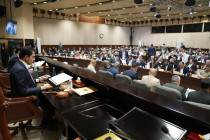
Political disputes, party quotas, and competing interests have stalled legislation in Iraq's parliament, political figures and analysts told Shafaq News, warning that disagreements over committee leadership and the delayed federal budget are undermining the institution's legislative and oversight roles, with consequences for citizens' rights and public services.
A Shafaq News review of parliamentary records showed a steady decline in legislative output, from 216 laws during the 2010–2014 term to 164 in 2014–2018 and 91 during the fourth term, which ended early in 2021. The figure dropped further to 69 in the fifth term, which ended in 2025.
The current parliament has approved just three laws since its sixth term began in late December 2025, through November 21, 2026. By comparison, lawmakers passed approximately 30 laws in the first legislative year of the 2014–2018 term, against only two in the first year of the 2022–2025 term.
The Cost of Political Consensus
Lawmaker Ahmed Dagher attributed the slowdown to political divisions, a lack of agreement on contentious bills, disputes over parliamentary committee appointments, and the failure to schedule votes on legislation already prepared for approval. Parliament had also extended its legislative session while awaiting the federal budget, which has yet to reach lawmakers.
Read more: Baghdad-Erbil budget dispute: What obstructs a deal?
Holding parliamentary leaders and political blocs responsible for addressing the delays, Dagher noted that continued inaction could obstruct legislation affecting citizens' rights, public services, economic opportunities, and living conditions while eroding public confidence in parliament.
Political analyst Mujashaa Al-Tamimi traced the problem to Iraq's consensus-based power-sharing system, arguing that parliament has become dependent on agreements within the State Administration Coalition (SAC), an alliance of more than 20 Shiite, Sunni, and Kurdish political parties and groups that agreed to form the government. Since the previous parliamentary term, he explained, these agreements have effectively become a prerequisite for legislation, government oversight, and accountability, restricting lawmakers' independence.
Al-Tamimi contrasted this arrangement with a parliamentary system in which a governing majority makes decisions while an opposition exercises oversight, affirming that Iraq's approach requires consultation and agreement among coalition partners before major legislation can advance.
Citing delays involving the federal budget, the oil and gas law, and legislation governing the Federal Supreme Court, he warned that continuing this approach would strip parliament of an essential part of its legislative and oversight role. “Overcoming the problem,” he maintained, “would require abandoning political consensus.”
Read more: Parliament adjourns with reform agenda intact and cabinet still incomplete
Key Laws Await Approval
Lawmaker Khalid Sido, who represents the Yazidis, a religious minority in Iraq, similarly blamed partisan interests and competition over ministries, parliamentary committee chairmanships, and other positions for obstructing legislative work, noting that numerous bills had undergone first or second readings without reaching a final vote.
Among them are proposals covering cybercrime, international crimes, traffic regulations, public service, and pensions. Sido highlighted the cybercrime bill for its provisions addressing blackmail and hate speech, while stressing that the international crimes legislation could help hold suspects accused of terrorist offenses who are already in custody accountable.
Parliament completed the first reading of the international crimes bill and the second reading of the proposed law combating information technology crimes on September 21, 2026, but neither has received final approval.
The budget delay has also affected compensation and other entitlements for the Yazidi community, Sido said, linking these difficulties to broader political disagreements obstructing state institutions.
He denied that parliament was on an official legislative recess but acknowledged that its inactivity while awaiting the budget from the Cabinet resembled one. Sido expected parliamentary activity to resume with the next legislative session, in approximately one to one and a half months, and expressed hope that several pending bills would then be put to a vote.
Read more: Months of parliament paralysis: Divisions, pressure expose Iraq’s fragile system
Calls for a Presidential System
Lawmaker Mukhtar Al-Mousawi blamed weak parliamentary leadership and what he described as declining government interest in the legislature for disrupting parliamentary sessions and complicating agreements on its management.
He also criticized the influence of political parties over lawmakers' decisions, adding that many parliamentary votes were shaped by "party pressure" rather than individual convictions.
Al-Mousawi called for consideration of a presidential system in which citizens directly elect the president, citing the experience of other countries as an alternative to Iraq's current parliamentary arrangement.