Iran opens Khamenei funeral week in Tehran


Shafaq News- Tehran
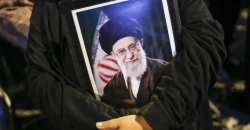
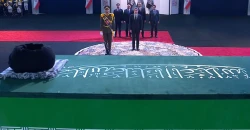
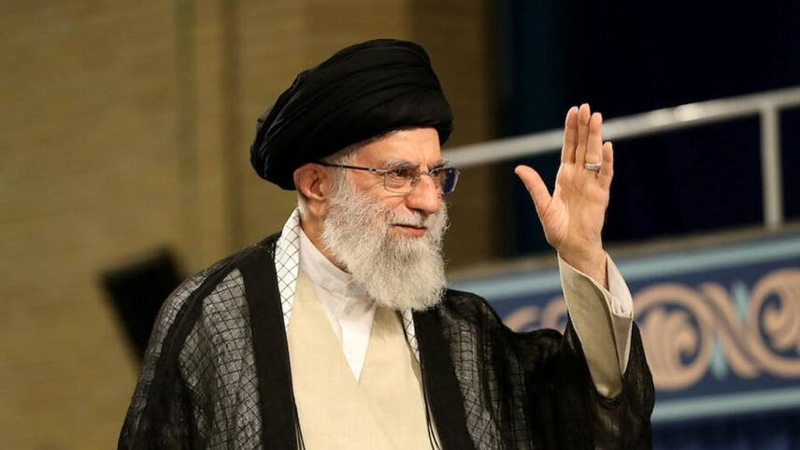
Iran held a tribute ceremony in Tehran on Friday dawn for the body of Ayatollah Ali Khamenei, the supreme leader who governed the Islamic Republic for 37 years before he was killed in a US-Israeli strike in late February, according to Iranian state media.
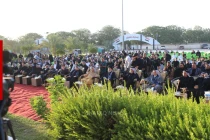
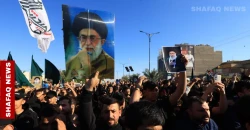
The ceremony drew intellectuals along with political and religious figures, opening a week of funeral rites set to end with his burial next Thursday.
The funeral committee designated Friday as an official day for paying respects, reserved for heads of delegations, officials, and religious leaders from various countries. Authorities imposed flight restrictions over Tehran for the day, citing the presence of visiting dignitaries.
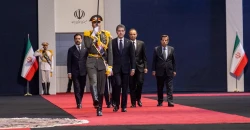
According to Tasnim News Agency, eight heads of state and 12 parliament speakers arrived in Tehran to participate in the ceremony, along with top officials from Malaysia, Lebanon, Iraq, Afghanistan, Norway, Pakistan, Russia, Tunisia, Senegal, India, Argentina, and Mexico. International delegations continue to arrive through Mehrabad and Imam Khomeini International Airports.
📹 ورود نخستوزیر ارمنستان به ایران برای حضور در مراسم ادای احترام به رهبر شهید انقلاب#بدرقه_آقای_شهید_ایران pic.twitter.com/XW6O8118Vr
— خبرگزاری تسنیم (@Tasnimnews_Fa) July 3, 2026
Khamenei's body was brought to the Imam Khomeini Grand Mosalla*, the capital's main venue for major state and religious gatherings, ahead of public farewell rites that open Saturday. An initial farewell was held overnight at the site where he was killed.
Funeral committee spokesman Iman Attarzadeh said that the first program took place after evening prayers on Thursday and was attended by families of war martyrs, families of staff killed at the leader's office, and members of the unit that had guarded him.
🎥 لحظه ورود پیکر آقای شهید ایران به مراسم وداع در جوار حسینیه امام خمینی (ره)#باید_برخاست pic.twitter.com/2pxMvhY7rD
— IRNA - ایرنا (@IRNA_1313) July 2, 2026
The Killing And Its Aftermath
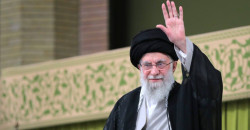
Khamenei was killed on February 28 in a strike on his compound in central Tehran, ending a 37-year tenure as supreme leader. Several relatives died in the same attack, including a daughter, a grandchild, a daughter-in-law, and a son-in-law. His son, Mojtaba Khamenei, has been appointed to succeed him but has not appeared in public since taking office.
The funeral was delayed for more than four months, a gap officials attribute to wartime conditions and security concerns. Ali Akbar Pourjamshidian, secretary of the national funeral committee, said officials from more than 30 countries and religious figures representing more than 90 countries had requested to attend. He expected participation in the Tehran procession to be between 12 million and 20 million people.
Iran has staged mass funerals before. When Ayatollah Ruhollah Khomeini, the republic's first supreme leader, died in 1989, an estimated ten million people lined the 20-mile route to the cemetery —about one-sixth of the country's population, the largest share of a nation ever recorded at a funeral procession— with between 2.5 and 3.5 million attending the burial. Roughly seven million people took part in the 2020 processions for General Qasem Soleimani, who was killed in a US strike in Baghdad.
📹 ادای احترام هیئتی از مجاهدان و شخصیتهای کتائب حزبالله عراق به رهبر شهید#بدرقه_آقای_شهید_ایران pic.twitter.com/eS7e3z2LTs
— خبرگزاری تسنیم (@Tasnimnews_Fa) July 3, 2026
The Question Of The Successor
A central question hanging over the ceremonies is whether the new supreme leader will appear in public for the first time since taking office. Mojtaba has not been seen at any event, and no video or audio recording of him has been released since his selection —only written letters. In one message, he said he had seen his father's body and face and that his father's fist "was clenched."
Mojtaba, 56, was wounded in the February 28 strike that killed his father and sustained serious injuries, according to Iranian officials. His prolonged absence has fueled speculation about both his health and whether he will attend the funeral. Pourjamshidian declined to confirm his participation, saying the decision rested with the supreme leader's office and was tied to security arrangements.
Few public figures report direct contact with him. Gholam Ali Haddad Adel, a former parliament speaker and Mojtaba's father-in-law, said in a televised interview that he had no information about Mojtaba's condition and had not seen him since before the war. President Masoud Pezeshkian is the only official to report a direct meeting, which he said lasted about two and a half hours; no images or details were released.
ورود پیکر مطهر شهیده زهرا محمدی گلپایگانی نوه ۳ ساله رهبر شهید انقلاب به مصلی تهران pic.twitter.com/h6FwhVrb9A
— خبرگزاری ایسنا (@isna_farsi) July 3, 2026
Security And Warnings
Iranian agencies fear that Israel or opposition groups could stage sabotage or bombings against the crowds or the proceedings, a concern cited as a principal reason for the four-month delay, and that threat assessment remains in place, leading to extraordinary measures and wide restrictions on traffic and entry into Tehran.
Tehran has paired those measures with a direct military warning to the United States and Israel of a harsh and immediate response to any attack during the funeral. Ali Abdollahi, commander of the Khatam al-Anbiya Central Headquarters, Iran's top joint military command, described Washington and Tel Aviv as Tehran's enemies and urged them to weigh the retaliation the armed forces would mount against any aggression. The warning followed a statement by Israeli Defense Minister Israel Katz, who described Mojtaba Khamenei as "marked for death." Foreign Minister Abbas Araghchi said Tehran would act immediately and forcefully against any threat to the Iranian people or its leadership.
The Funeral Schedule
The public farewell opens at the Imam Khomeini Grand Mosalla at 6:00 a.m. on Saturday and runs around the clock, with a funeral prayer for Khamenei and his relatives set for Sunday. A procession through Tehran is scheduled for Monday along an east-to-west route taking in Damavand, Enghelab, and Azadi streets. Tehran's metro will run 24 hours a day free of charge during the ceremonies, and the stock exchange will close on the farewell and procession days.
Ceremonies then move to the Shiite holy city of Qom on Tuesday and to the Iraqi shrine cities of Najaf and Karbala on Wednesday. Burial is set for Thursday, July 9, in the northeastern city of Mashhad, at the shrine of Imam Ali bin Musa al-Rida, widely known as Imam Reza, the eighth Shia Imam, according to the funeral committee.
*A mosalla is a large open prayer ground used for major religious gatherings and holiday prayers, distinct from a covered mosque.
"مشاركة ضيوف أجانب من نحو 100 دولة في مراسم وداع جثمان القائد الشهيد" https://t.co/y69NSNl0L8
— وكالة مهر للأنباء (@mehrnewsarabic) July 2, 2026