Jurf al-Sakhr and Iraq's push to disarm factions


Shafaq News
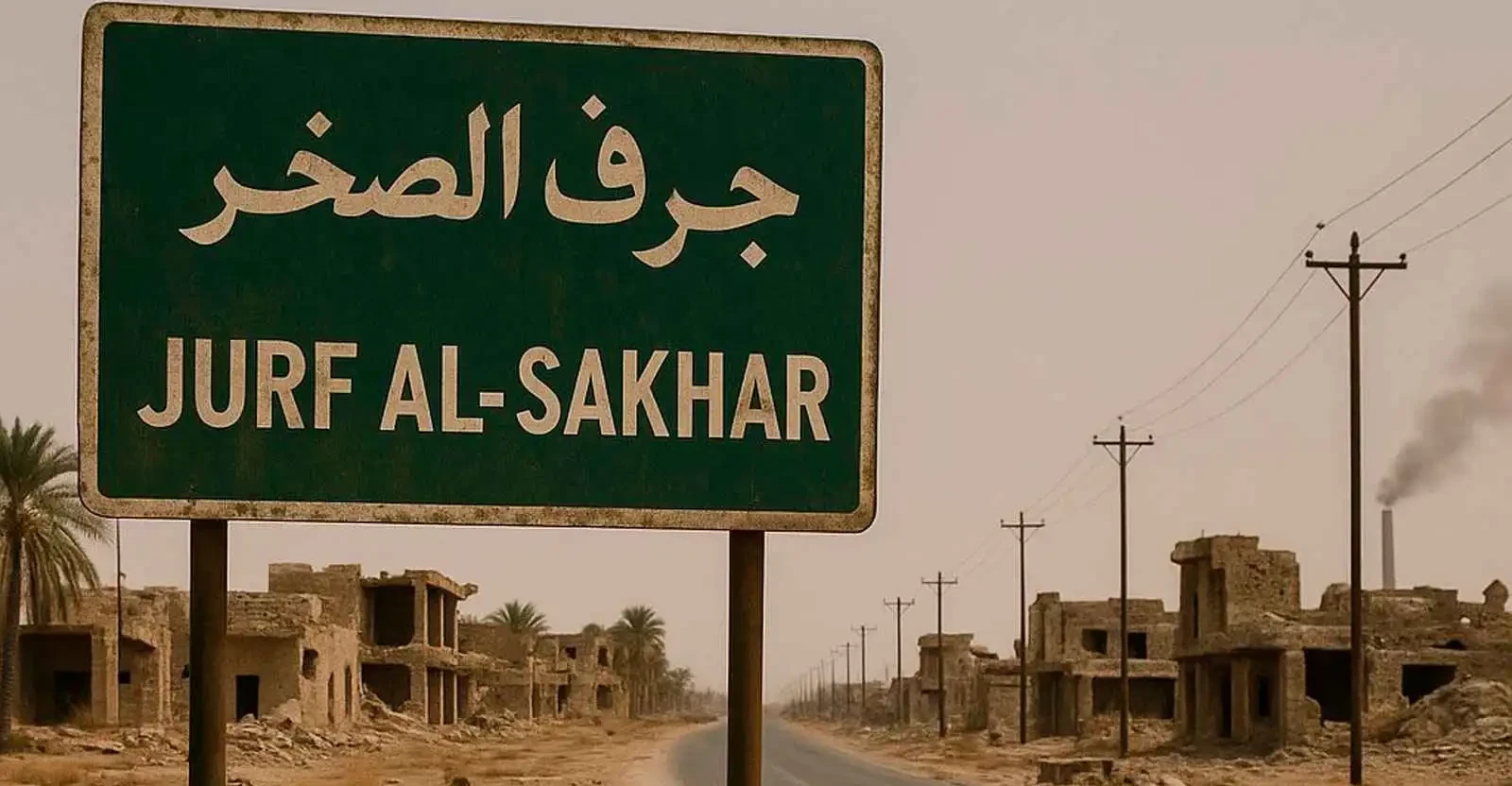
Jurf al-Sakhr, a largely depopulated farming district in northern Babil province, has returned to the center of Iraqi politics as Baghdad presses armed groups to place their weapons under state control before a September 30 deadline. More than a decade after it was retaken from ISIS and renamed Jurf al-Nasr, the district’s residents are still displaced, and parts of the district remain under the control of factions within the Popular Mobilization Forces (PMF), the state-linked, mostly Shia network of armed groups formed to fight ISIS in 2014.
The dispute now runs on two tracks at once. One is humanitarian: thousands of families who fled a decade ago have never been allowed home. The other is strategic: the same closed zone has been named in successive official reports as a base for armed factions and a target of foreign airstrikes.
A Strategic Pocket South Of Baghdad
Jurf al-Sakhr sits roughly 60 kilometers southwest of Baghdad and about 13 kilometers north of the town of al-Musayyib. Its orchards, irrigation drains, and waterlogged flats are hard to police, and it straddles routes linking the capital to central and southern Iraq, including the Shia holy cities of Karbala and Najaf, and to Al-Anbar province in the west.
That geography made the area a security problem long before ISIS. After the 2003 US-led invasion, the district fell inside what Iraqi forces called the Triangle of Death, the farming belt directly south of Baghdad, taking in Mahmoudiyah, Latifiyah, and Yusufiyah and reaching Iskandariya and Jurf al-Sakhr, where al-Qaeda and other armed groups exploited the terrain during the sectarian war. The same name is now also used for a separate northern zone across Diyala, Kirkuk, and Saladin provinces.
When ISIS swept through in 2014, Jurf al-Sakhr became one of its footholds in northern Babil, and displacement began even before the fight to retake it; the Iraqi Red Crescent Society reported in May 2014 that roughly 900 families had already fled areas tied to the district.
From Battlefield To Sealed Zone
The turning point came that autumn. An operation known as the Ashura offensive began on October 23, 2014, drawing Iraqi forces and PMF factions, and the district was retaken within days. Iraqi authorities argued at the time that leaving ISIS in place there would have threatened the approaches to Karbala, Najaf, and Babil.
Recapture did not reopen it. The forces and factions that fought there stayed, and Jurf al-Sakhr hardened into a closed military zone where the armed factions maintained a dominant security presence. Several groups controlled it in the early years, among them Kataib Hezbollah, one of the most powerful Iran-aligned factions inside the PMF.
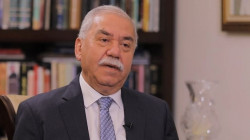
Hassan Fad'am, a former member of parliament for Babil and a leader in the al-Hikma movement of Ammar al-Hakim, a Shia political bloc that maintains no armed factions, says more than 70 percent of residents left during ISIS rule rather than after liberation, and that troops who entered afterward found the district "fully mined and booby-trapped." Clearing it, he argues, would require extensive technical work and government resources, and the case should not become a sectarian or political weapon. Residents and opponents of the factions counter that a closure now approaching twelve years exceeded any demining rationale and became a permanent military and political fact.
Read more: Days to disarm Iraq's factions: deadline or negotiable ceiling?
Twelve Years Of Displacement
Government figures over the past two years show the displacement crisis remains, though the numbers shift with each registration cycle. Iraq's Ministry of Migration and Displacement said in May 2024 that about 6,000 displaced families from Jurf al-Sakhr had yet to return.
For those still out, the loss extends beyond housing. Political researcher Abdul Qader al-Nayel says some residents have spent close to a decade in displacement camps, pointing to the Bzeibez camp in Al-Anbar province, which he estimates now holds between 1,360 and 1,400 families. Most were farmers, he notes, and many now depend on aid after losing their land and orchards, with years of displacement taking a growing toll on families and children's access to basic services.
Read more: What happens to Iraq's armed factions after September 30?
A Wider Map Of Areas Outside State Control
Security sources describe Jurf al-Sakhr as one of several areas where the state's authority remains limited. One source told Shafaq News that close to 20 armed groups and factions hold territory where the army and police are kept out, and security cordons are imposed by the factions themselves. Another source pointed to weapons workshops and depots inside several of them, said to hold drones and Iranian medium- and long-range missiles, along with unofficial prisons and detention sites.
In Iraqi commentary, these places are often called the depopulated, or "dark," cities. Their combined pre-displacement population, according to figures provided by the security source, is put at around 1.25 million people, almost all Sunni, now spread across 13 camps in Al-Anbar, the outskirts of Baghdad, Saladin, and Nineveh, and across Erbil, Al-Sulaymaniyah, and Duhok in the Kurdistan Region. Together, the zones cover more than 3,000 square kilometers. Besides Jurf al-Sakhr, they include parts of al-Musayyib and the area east of Latifiyah in northern Babil; al-Awja, and the outskirts of Tikrit in Saladin; and stretches of Al-Anbar and Nineveh that run to the Syrian border.
Senior Sunni politicians have described Jurf al-Sakhr in blunt terms. Muhammad al-Halbousi, head of Taqadum, the largest Sunni party, called it a camp for the armed factions that “no one is able to enter.”
Read more: Iraq's September deadline undercuts armed factions' case for weapons
A Site Linked To Weapons And Strikes
What sets Jurf al-Sakhr apart from other cases of post-ISIS displacement is the military activity reported inside it. In 2018, Reuters reported, citing Iranian officials and Iraqi and Western intelligence sources, that Iran had moved short-range ballistic missiles to Iraq and named the district among sites said to be used for storage. Later reports pointed to workshops said to be developing missiles and drones, claims that have deepened the secrecy around the area without independent confirmation.
The district has also been struck repeatedly. Sites inside it were hit in a US strike in January 2024, and again on July 30, 2024, when the PMF Commission said four of its members were killed in three strikes on one of its positions; Washington described that strike as defensive, launched after it detected preparations for an attack on US forces. Two further rounds of airstrikes hit PMF sites in the district on February 28 and March 31, 2026; reports attributed those to the United States and Israel, though neither formally claimed responsibility.
A Symbol In Iraq's Sectarian Politics
Over the years, the district has become shorthand for Iraq's wider Sunni-Shia and state-versus-faction disputes. In 2017, the Babil provincial council voted to pursue political actors who demanded the return of the displaced, while Sunni politicians kept pressing for it. In April 2023, the head of the Sunni-led Sovereignty Alliance (Al-Siyada), Khamis al-Khanjar, declared, "We will pray in Jurf soon," a reference to the residents' return that drew a sharp rejection from faction leaders, who warned against readmitting people they accuse of ISIS ties.
That accusation is what makes the issue so combustible, since almost any statement about Jurf al-Sakhr can be read along sectarian lines. Fad'am warns against turning it into a sectarian, political, or media issue, arguing that such framing has itself blocked returns.
“Years in the camps have bred a deep sense of grievance and weakened residents' trust in the state, making reconciliation harder the longer it lasts,” Al-Nayel adds.
Read more: Jurf Al-Sakhar: A decade on, Iraq's displaced still barred from return
The Government's Next Move
The latest return to prominence is tied directly to Baghdad's push for a state monopoly on weapons. The government of Prime Minister Ali al-Zaidi, who took office in May 2026 backed by the State Administration Coalition, a grouping of Sunni, Shia, and Kurdish parties, and with US support, has set September 30 as the deadline for armed groups to bring their weapons under state control, a date that also marks the scheduled end of the US-led coalition's mission in Iraq. Government spokesman Haidar al-Aboudi has said any weapons outside state institutions after that date will be treated under the law, including counter-terrorism law. Kataib Hezbollah is among the factions that have tied the future of their weapons to the withdrawal of foreign forces.
Against that backdrop, a government committee grouping the interior, justice, and agriculture ministries with the PMF Commission has begun fieldwork in Jurf al-Sakhr, where Kataib Hezbollah controls security in parts of the area. The broader plan relies on restricting access to sensitive sites rather than conducting direct raids, in an effort to avoid armed confrontation.
The competing readings persist. Babil provincial council member Mohammed al-Mansouri frames the question not as a choice between reopening the district and keeping it closed, but as a duty to return residents while safeguarding the province, noting that Babil has previously been attacked from areas near the district.
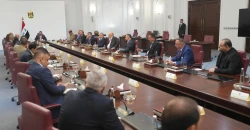
Security expert Sarmad al-Bayati argues the issue has been left unresolved so long that it has taken “on the quality of a myth, thickened by years of political and media claims,” and says any settlement must begin by bringing the federal government, the security services, the factions, and the residents to one table to fix the area's legal and security status before mapping a route home.
For now, any path toward resolving Jurf al-Sakhr runs through the committee's work and the Sept. 30 deadline, after which al-Aboudi says weapons held outside state control will be subject to legal action.
Written and edited by Shafaq News staff.