Iraqi armed factions divided on disarmament: Strategic gamble or major shift?


Shafaq News
Several leading Iran-aligned Iraqi armed faction leaders unexpectedly announced their acceptance of disarmament initiatives, a subject that until recently sparked some of the sharpest divisions in Iraq’s political arena. Not all factions joined the move, as Kataib Hezbollah and Harakat al-Nujaba reaffirmed their refusal to relinquish their weapons.
Previously, these initiatives had faced intense opposition from faction leaders and influential political figures aligned with them. Until recently, the proposals were condemned as conspiratorial attempts aimed at undermining Iraq’s political system, particularly Shiite influence, as a prelude to its destabilization.
The sudden shift has prompted debate over whether it reflects a coordinated political maneuver, internal disagreements among factions, or a reassessment by groups such as Asaib Ahl al-Haq, which appear to regard their enhanced presence within state institutions as sufficient protection without arms. Analysts note that the development is part of a long trajectory that has now reached a critical juncture.
Read more: Iraq’s armed factions, state authority, and the battle over disarmament
Regional Context
Regional developments have significantly shaped the new discourse. Following the announcement by the “Islamic Resistance in Iraq” factions to suspend operations against US forces in Iraq and the broader region in late January 2024, the status quo began to change amid escalating regional tensions triggered by Gaza-related operations after October 7.
Most factions withdrew from operations targeting US bases, and subsequent US strikes killed senior Kataib Hezbollah figures without provoking retaliatory action. These strikes were in response to a drone attack that killed American soldiers near the Iraqi-Syrian-Jordanian border.
Setbacks elsewhere in the region further influenced faction calculations. Hezbollah suffered a major military and security blow in Lebanon, demonstrating the potential consequences for Iran’s allies if conflict spread to their areas of operation. The collapse of Bashar al-Assad’s government in December 2024 marked another strategic setback for Iran and its regional partners, constricting their political and military maneuvering space.
Within Iraq, discussions intensified over disarming factions to prevent a potential conflict from spilling into the country. This coincided with increased US sanctions on Iraqi figures accused of ties to Iran’s Islamic Revolutionary Guard Corps and the suspension of sanctions waivers on Iranian gas imports, Iraq’s primary electricity source.
While a degree of stability prevailed during the parliamentary election period, it was widely seen as temporary. The election outcomes largely favored moderation, with Shiite forces retaining a comfortable parliamentary majority, yet the issue of limiting weapons to state control resurfaced decisively.
Renewed momentum followed the appointment of US envoy Mark Savaya to Iraq, who consistently emphasized weapons restrictions as a top priority for Washington.
Complex Calculations
Kataib Hezbollah and Harakat al-Nujaba’s continued refusal to disarm was predictable, given their superior military and security capabilities compared to factions like Asaib Ahl al-Haq, Ansar Allah Al-Awfiya, Kataib Al-Imam Ali, and Kataib Sayyid Al-Shuhada. While Asaib Ahl Al-Haq remains a significant force outside state authority, analysts highlight a clear imbalance of power, with the factions firmly opposing disarmament.
Kataib Hezbollah and Harakat Hezbollah al-Nujaba are leading Iran-aligned Iraqi Shiite armed factions and core components of the “Islamic Resistance in Iraq,” operating in close coordination with Iran’s IRGC-Quds Force.
Both groups are ideologically rigid, adhere to Shiite doctrine and Wilayat al-Faqih, and frame armed struggle as a permanent religious obligation tied to broader Islamic governance and resistance objectives.
Each is formally incorporated into Iraq’s Popular Mobilization Forces, granting legal status, state funding, and institutional access, while simultaneously retaining independent command structures and strategic autonomy from the Iraqi state.
Kataib Hezbollah was founded by Abu Mahdi al-Muhandis and is currently led by Ahmad Mohsen Faraj Al-Hamidawi, while al-Nujaba was founded and continues to be led by Akram al-Kaabi, with both leaders designated as terrorists by the United States.
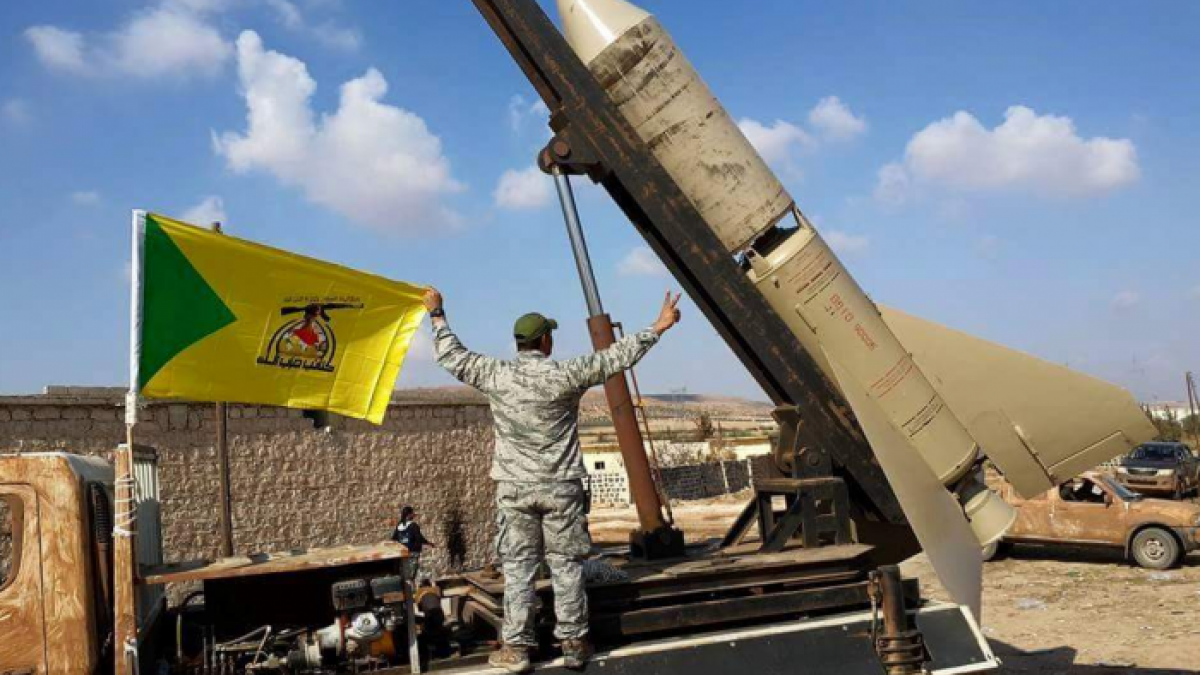
Militarily, the two factions field multiple combat brigades, maintain strongholds across Baghdad and other strategic Iraqi provinces, and possess rockets, drones, and missile capabilities with cross-border reach.
Both groups have expanded their operational footprint beyond Iraq, particularly into Syria, and emphasize transnational resistance rather than exclusive territorial defense of the Iraqi state.
Since October 2023, Kataib Hezbollah and al-Nujaba have played central roles in or claimed association with rocket and drone attacks targeting US forces, often under a shared resistance banner.
Each organization relies on PMF-linked resources and Iranian support, remains outside or only indirectly engaged in formal Iraqi politics, and is designated a terrorist organization by the United States.
Read more:Zero-sum game: Can the Iran-Israel conflict push Iraq toward frontline?
Absorptive Maneuver or New Stance?
Although rhetoric is evolving, it remains premature to evaluate the trajectory of disarmament definitively. Iran has yet to issue a public stance and is unlikely to do so formally. The political framework accompanying any disarmament effort remains in early stages, with no certainty that it will proceed as envisioned by supporters.
Time is required to verify whether guarantees sought by factions willing to disarm will be honored. Meanwhile, factions opposing disarmament face unprecedented pressure due to internal divisions, the Coordination Framework’s support to disarmament, Iran’s reluctance to escalate regionally amid potential conflict with Israel, and the deteriorating position of allied groups across the region.
Another likely scenario involves a distribution of roles among factions, keeping the issue in negotiation rather than forcing a decisive outcome. This mirrors the Lebanese model, where Hezbollah surrendered weapons south of the Litani River while retaining arms elsewhere, balancing political maneuvering with capability retention. A similar path in Iraq could result in a prolonged mix of political negotiation and security tension, contingent on Washington’s willingness to accept this arrangement.
Read more: Diverging views emerge on disarming Armed Factions in the Middle East