Iraq's al-Zaidi rebalances Iran ties before Washington visit


Shafaq News
Iraqi Prime Minister Ali al-Zaidi is testing a proposition that has eluded every Baghdad government since 2003: that Iraq can assert greater sovereign control over its own affairs, and deal with Iran from a position of parity rather than dependence, without severing a relationship that geography, security, faith, and trade have made essential.
The events of a single week, unfolding ahead of his coming visit to Washington, scheduled on July 15, cut in both directions at once. A corruption sweep fell heaviest on networks, some of them directly or indirectly, tied to Tehran allies, and Baghdad was kept clear of a politically charged funeral of Ayatollah Ali Khamenei. Yet the Iranian president, Masoud Pezeshkian, stood in Najaf reaffirming the depth of the bond; the Quds Forces leader Esmail Qaani arrived unobstructed, and al-Zaidi himself sent warm condolences and accepted an invitation to Tehran. Read together, these are less the opening moves of a pivot than the calibrations of a hedge.
What is at stake is the balance that has defined Iraqi statehood for two decades, and the terms, not the existence, of Iraq's tie to its most powerful neighbor. Since the US-led invasion toppled Saddam Hussein in 2003, Iran has filled the vacuum through allied political parties and armed factions, most consolidated under the Popular Mobilization Forces (Al-Hashd al-Shaabi, PMF), an umbrella of predominantly Shia formally folded into Iraq's security structure but, in practice, most of its brigades are answerable to the Islamic Revolutionary Guard Corps. Washington describes the result as a sovereignty compromised from within. But the relationship al-Zaidi inherited is not one he can simply cut, nor one he shows any intention of cutting: a shared border running the length of Iraq's east, extensive cross-border trade, the shrine cities, and deep Shia religious ties bind the two states regardless of who governs in Baghdad. His task is narrower and harder than rupture: to loosen Tehran's hold on the machinery of the Iraqi state while keeping the state's relationship with Tehran intact.
Read more: Iraq's September 30 weapons deadline leaves terms of disarmament unresolved
The paradox of his position is that the coalition now unsettled by his direction is the one that installed him. Al-Zaidi was chosen by the Coordination Framework, the dominant Shia parliamentary bloc built on close ties to Tehran, after Washington vetoed the return of former prime minister Nouri al-Maliki. He governs on the sufferance of the very forces he is testing, a dependency that sets the ceiling on how far and how fast he can move.
Read more: Iraq’s balance policy: When neutrality becomes a forced compromise
That ceiling was on display in the arrangements for the funeral rites of Ali Khamenei. Tehran had proposed ceremonies across Iraq, including a formal service in Baghdad. Iraqi sources told Shafaq News that al-Zaidi's government, backed by Washington, refused, confining the rites to the Shia shrine cities of Najaf and Karbala as acts of popular and religious mourning while denying them any political staging in the capital. The refusal produced sharp exchanges between al-Zaidi and Iranian Foreign Minister Abbas Araghchi. After sustained Iranian pressure and lobbying from pro-Tehran Iraqi leaders, the compromise held: mourning in the shrine cities, nothing in Baghdad.
Paul Davis, an assistant professor at the Institute of World Politics in Washington who studies Iraqi security, read the protocol as deliberate. The exclusion of Baghdad, he told Shafaq News, “represents a striking indicator of the nature of the new relationship the Iraqi government is trying to draw with Tehran.” Historical and sectarian ties made Iraqi participation natural; the capital's calculated absence carried political meaning that could not be dismissed as logistics.
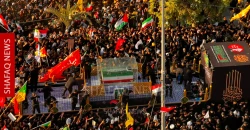
But the line Baghdad drew was around the venue, not the relationship, and in Najaf, the relationship was on full display. Iranian President Masoud Pezeshkian attended the shrine-city rites in person on Tuesday, using the occasion to reaffirm the depth of ties between the Iranian and Iraqi peoples and to cast the bond as popular and enduring rather than the imposed dependency Washington describes. He invited al-Zaidi to visit Tehran, an overture that mirrored, rather than answered, the invitation already extended from Washington. His presence signaled Tehran's confidence that the ceremonies Baghdad permitted still offered a substantial stage, even with the capital closed to them.
The question that had most exercised observers —whether Baghdad would bar Esmail Qaani, commander of the Guard Corps' expeditionary Quds Force— resolved on its own terms. Reports had circulated that Iraq signaled Qaani would not be welcome; blocs aligned with Tehran denied them flatly, with Firas al-Muslamawi of the Reconstruction and Development Coalition calling the account baseless and Amer al-Fayez of the Tasmeem bloc arguing it was designed to strain relations between the two capitals.
Qaani then arrived unobstructed on Tuesday, landing at Baghdad International Airport before continuing to the shrine cities. He crossed no line al-Zaidi had drawn: the ceremonies stayed in Najaf and Karbala, and the capital hosted no service. Davis had cautioned that restrictions on Qaani, had they held, would have amounted to “a highly significant signal”; its absence marked the distance between the rebalancing al-Zaidi is testing and the one his partners are prepared to permit.
Al-Zaidi's own conduct pointed the same way. In an official statement, he offered condolences to the Iranian people and government over what he called the “martyrdom” of Khamenei, deferential language no government pursuing rupture would reach for, and affirmed the depth of relations between the two countries and his keenness to strengthen them across various fields. He stressed the need for precision and care in dealing at every regional and international level to entrench stability and halt conflicts. It was the vocabulary of a leader managing a relationship, not ending one.
The most consequential move was on June 28, when Iraqi security forces launched Operation Dawn Assault, sweeping through Baghdad and several Shia-dominant provinces such as Dhi Qar and Basra to detain politicians, sitting members of parliament, and businessmen on corruption charges. Government spokesman Haidar al-Aboudi confirmed 67 arrests. Al-Zaidi told his cabinet the campaign was a “first phase,” pledged to recover looted public funds, and instructed oversight bodies to gather evidence of ministerial malfeasance.
Read more: Iraq detains top officials in anti-corruption sweep: What we know so far
Inside the investigation, a senior government source told Shafaq News that the detainees held under the Dawn Crackdown are being questioned daily under strict secrecy measures that bar visits from political parties, lawyers, and outside contacts to prevent leaks that could allow suspects to flee the country, conceal evidence, or influence proceedings.
Legal procedures for a second phase are already complete, covering corruption files in the health, oil, and electricity ministries, and tracing funds, properties, and investment projects linked to officials in the United States, Europe, and Turkiye. A new list of accused individuals is being prepared alongside a review of an illicit enrichment bill.
Corruption in Iraq saturates the state, and a genuinely neutral campaign would implicate nearly every faction. Analysts read the operation's early targeting as falling disproportionately on the patronage networks of Iran-aligned parties and armed forces, the structures Washington has named as the barrier to a closer partnership. But where that targeting leads, and how far it is meant to reach, is itself contested.
In an analysis published by Shafaq News, Shwan Zangana argued that the campaign is being deliberately bounded. Washington, in his reading, will confine the Dawn Crackdown anti-corruption operation to smuggling and its associated corruption and will not permit it to reach the wider class of Iraqi corruption, because doing so would destabilize a political order the Trump administration is trying to entrench under al-Zaidi. Seen this way, the operation is less an anti-Iran offensive than a controlled instrument for consolidating a US-backed central authority.
David Des Roches, an associate professor at the Near East South Asia Center for Strategic Studies and a former director of policy in the office of the US secretary of defense, told Shafaq News that “there are unannounced American expectations that political and security figures linked to Tehran must be pushed out of the Iraqi scene.” Washington has long treated Iranian-backed corruption as the central obstacle to a real relationship, he said, viewing Iraq as a state of diminished sovereignty “so long as militias funded by the Iraqi treasury answer to a foreign power.” Any Iraqi move against that system would be welcomed, but not without anxiety about the response.
That anxiety is grounded in precedent Des Roches drew from Lebanon. The Guard Corps, he said, has a playbook of threatening a country with collapse when it judges Iranian interests at risk, and the same instrument exists in Iraq. With Hezbollah degraded, Iraq's armed forces have become the most potent remaining component of Iran's regional network, which raises, rather than lowers, the stakes of confronting them. Washington judges the consolidation of state authority worth pursuing even so, “even if it is difficult and comes with some pain.”
He pointed to the New York prosecution of Mohammed Baqir al-Saadi, who was arrested by US authorities over alleged plots targeting Americans and Jews in Europe and Canada, as the kind of case that concentrates American attention.
The leverage is concrete. President Donald Trump has invited al-Zaidi to Washington but paired the welcome with the threat of sanctions, tying the release of roughly $500 million in Iraqi oil revenue to compliance with hard conditions: monopolizing weapons in state hands, decoupling from Iran, and barring armed factions from political representation.
Read more: Iraq's oil revenues under US financial guard 23 years after invasion
Set beside Pezeshkian's competing invitation to Tehran, the visit captures al-Zaidi's predicament exactly, courted by both capitals, expected by each to move against the other, and able to fully satisfy neither.
The pro-Tehran factions are contesting the pivot narrative directly. Abd al-Rahman al-Jazairi, who heads the political body of the National Section current within the State of Law coalition, rejected the notion that Qaani was ever unwelcome. Qaani is a military commander, he told Shafaq News, and his visits concern Iraqi-Iranian coordination on shared border security and economic files, not Iraq's internal politics. No Iraqi leader had informed Tehran otherwise, an argument Qaani's unobstructed arrival appeared to bear out. The framing recasts Iranian military presence as routine statecraft and denies al-Zaidi the ground he is trying to claim.
Here Iraq's dilemma comes into focus. Al-Zaidi cannot move decisively against “militia autonomy” without fracturing the majority that sustains him; he also cannot meet Washington's conditions without his partners reading compliance as betrayal; and he cannot sever the Iranian relationship even if he wished to, given the border, the trade, and the shrines that outlast any government. Twice before —in 2018, and again in 2020 and 2021— Iraqi governments moved against “militia autonomy,” but they absorbed the pressure, adapted, and returned through the political process. What is different now is external leverage: American money and recognition made conditional on results. Whether that changes an outcome precedent has already written twice will be revealed in the coming months.
For now, al-Zaidi is doing something more deliberate than choosing a side: he is keeping the direction unreadable, reassuring Tehran in public and in ceremony and courts Washington's money. That ambiguity may be the strategy, the posture that keeps both patrons engaged and his own coalition intact.
Read more: Iraq between two fires: Tehran and Washington eye Baghdad’s post-election phase
Iraq's balance between Washington and Tehran has stopped being a fixed point and become a live negotiation. What no one in Baghdad has yet shown is that the balance can be shifted at all without breaking the government that attempts it.
Written and edited by Shafaq News staff.