Iraq’s 2025 Parliamentary Elections — What You Need to Know


Shafaq News (Updated on Nov. 8 at 09:22)
Iraq will hold its next parliamentary elections on Tuesday, 11 November 2025, under the supervision of the Independent High Electoral Commission (IHEC).
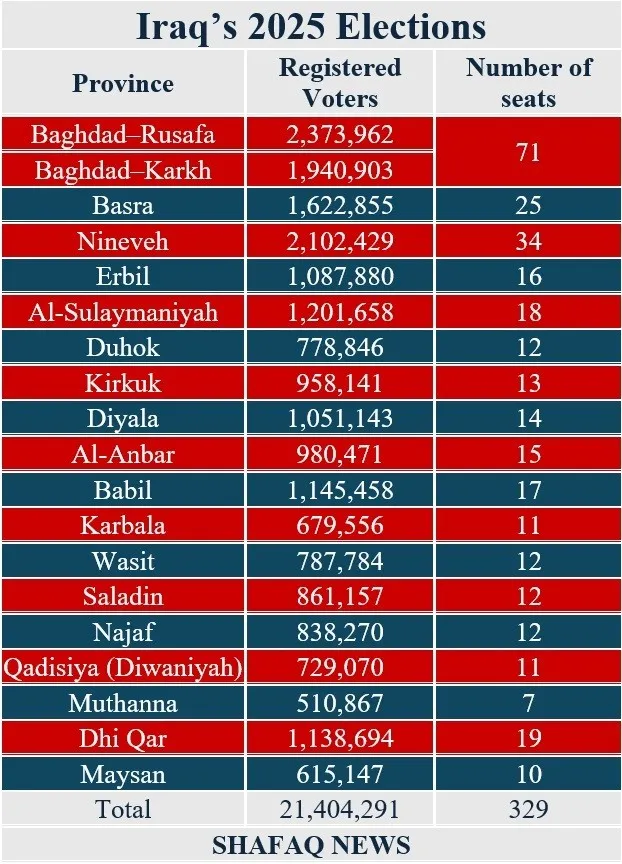
The total number of registered candidates currently stands at 7,744, while the review process continues under the Commission’s legal standards and regulations. A total of 31 coalitions, 38 political parties, and 75 independent lists are competing for 329 seats in the Council of Representatives, Iraq’s main legislative body.
848 candidates have been excluded from the upcoming race.
Who Can Vote
Eligible voters must be Iraqi citizens, legally competent, aged 18 years or older in the election year, registered in the national electoral rolls, and holders of an electronic voter card.
The general vote includes all eligible Iraqis inside the country and registered Iraqi citizens abroad. Participants include civilians such as public-sector employees, private-sector workers, students, and other citizens not serving in the security or military services.
Special Voting (the Special Ballot)
Special voting is a dedicated polling phase held two to three days before the general vote for specific voter groups unable to reach ordinary polling centers on election day.
Eligible categories include:
-Members of the army, police, and Popular Mobilization Forces (PMF),
-Internally displaced persons (IDPs) living in camps,
-Eligible inmates permitted to vote under electoral regulations.
For the 2025 electoral cycle, special voting is scheduled forSunday, 9 November 2025.
Legal Framework and Districting
The 2025 elections are governed by Law No. 4 of 2023, passed on 27 March 2023, amending Law No. 12 of 2018 on elections to the Council of Representatives and to provincial and district councils.
Each of Iraq’s 18 provinces (excluding Halabja) serves as a single electoral district, and seat allocation follows the Sainte-Laguë 1.7 method. Under this formula, the total number of valid votes in a province is divided by the number of seats assigned to that province to determine the electoral quota—the indicative number of votes required for one seat.
Seats are distributed proportionally among lists according to their vote shares, and remaining seats are allocated based on the Sainte-Laguë divisors (1.7, 3, 5, 7, etc.). Within each winning list, candidates with the highest individual vote totals occupy the available seats.
Quotas
-Women’s Quota: At least 25% of total parliamentary seats are reserved for women. If direct election results in a province fall short of this threshold, the quota is completed using the highest-polling female candidates, including—if necessary—those from non-winning lists, to meet the minimum required by law.
-Minority (Component) Quotas: Reserved seats are allocated for Christians, Sabean-Mandaeans, Yazidis, Shabak, and Fayli Kurds. These seats go to the highest-polling candidates within their respective communities at the provincial or national level as defined by law.
Results, Audits, and Appeals
A 24-hour silence period begins before polling, during which campaigning is strictly prohibited.
Preliminary results are typically announced within 24 hours after polls close. Final results are issued after electronic audits, manual recounts (if required), and the adjudication of complaints and appeals by IHEC and the Judicial Electoral Panel, operating under the Supreme Judicial Council.
Manual recounts are conducted in polling stations where irregularities are suspected, where discrepancies exceed the allowed threshold, or upon order of the Judicial Electoral Panel.
Complaints may be filed by political entities or candidates within 72 hours of the result announcements.
Appeals against IHEC decisions must be resolved by the Judicial Electoral Panel within 10 days, after which final results are sent to the Federal Supreme Court for ratification, rendering them official and binding.
Voter Registry and Electoral Offenses
IHEC verifies and updates the electoral rolls using biometric fingerprint data, in cooperation with the Interior and Planning Ministries, to prevent duplication and multiple voting.
Criminal penalties for proven electoral violations include imprisonment and fines up to five million Iraqi dinars (approximately USD 3,780) for offenses such as ballot tampering, theft, coercion of voters, or deliberate impersonation.
Administrative sanctions may include candidate disqualification or annulment of results at affected polling stations, by decision of IHEC or the Judicial Electoral Panel.
Alliances
Key Shia-Majority Alliances
-Reconstruction and Development Alliance – led by Prime Minister Mohammed Shia al-Sudani
Formed ahead of the 2025 elections, it brings together seven political entities, including Falih al-Fayyadh and Ayad Allawi, as well as independents and tribal figures. The alliance focuses on reconstruction and economic reform while aiming to consolidate leadership within Shia coordination frameworks and secure a significant parliamentary bloc for potential government formation.
-State of Law Coalition – led by Nouri al-Maliki
A major Shia alliance with strong bases in central and southern Iraq. Comprising 11 parties, including the Islamic Dawa Party, Iraqi Turkmen Islamic Union, and Bashaer Youth Movement, it also runs satellite lists in several provinces, such as al-Hadba’a National (Nineveh), Diyala First, and Saladin Slate.
Seat record: 25 seats (2018) → 33 seats (2021).
National State Forces Alliance – led by Ammar al-Hakim
A moderate, reform-oriented current emphasizing national unity. It primarily partnered with Haider al-Abadi’s Victory Alliance (Al-Nasr,) which has withdrawn from the 2025 race.
Seat record: from 19 seats (2018) to 4 seats (2021) within the joint list.
Badr List – led by Hadi al-Amiri
A core component of the Shia Coordination Framework, with strong organizational structures and influence in Diyala, Basra, and Wasit.
Seat record: 48 seats (2018) → 17 seats (2021).
Sadiqoun List – led by Qais al-Khazali
Running under the same name as in 2021, the list seeks broader outreach through tribal alliances in areas such as Tikrit, where it has nominated candidates, including Dr. Awan Kazem Aziz al-Tikriti. It also benefits from coordination with the current government and aims to translate institutional footholds into electoral gains.
Seats (2021): 17.
Abshir Ya Iraq Alliance – led by Hamam Hamoudi
Includes seven groups such as the Islamic Supreme Council of Iraq, Iqtidar Watan (Abdul-Hussein Abtan), National Foundations Gathering, and New Iraq Gathering. Some candidates have links to armed factions, though such affiliations are not formally declared.
Iraqi al-Asas Coalition – led by First Deputy Speaker Ali Mohsen Akbar al-Mandlawi
An eight-party coalition including al-Watad al-Iraqi, and National Iraq Movement. Appeals to youth and independents; largely distant from Iranian influence. It won two seats across ten provinces in the latest provincial elections.
Tasmeem Alliance – led by MP Amer al-Fayez
Includes the Istimrar Party of Basra Governor Asaad al-Eidani and the Justice and Unity Gathering. Focuses on “national moderation” and local governance, expected to perform strongly in Basra.
The Patriotic Shiite Movement led by Muqtada Al-Sadr has not formally registered for the elections. Based on prior statements and current indicators, its continued boycott remains likely.
The absence of the country’s most organized electoral machine—previously holding 73 seats after the 2021 vote—could lower turnout in its strongholds and reshape Shia dynamics.
Read more: Iraq’s 2025 Elections: Shiite giants clash for Soul of the House
Leading Sunni Alliances
Sovereignty (al-Siyada) – led by Khamis al-Khanjar
Once Iraq’s largest Sunni bloc after 2021, it later separated from Speaker Mohammed al-Halbousi’s camp. Retains influence in Al-Anbar and Saladin, emphasizing Sunni rights within a unified Iraqi framework.
Taqaddum (Progress) – led by Speaker Mohammed al-Halbousi
An alliance with urban strength in Al-Anbar and outreach into Baghdad and Saladin. It promotes governance efficiency and developmental priorities, with openness to post-election coalitions.
In the 2021 parliamentary elections, the alliance won 37 seats, becoming one of the leading Sunni blocs.
Azm – led by Muthanna al-Samarrai
Operates mainly in Saladin (Baiji, al-Shirqat, Samarra) and parts of Nineveh. Relies on local and tribal networks and seeks to play a negotiating role in parliament.
Al-Hasm al-Watani – led by Thabit Mohammed Saeed
A five-party coalition, including Hasm for Reform, al-Wafa, and al-Hal, with influence in Al-Anbar, Nineveh, and Saladin.
Read more: Iraq's 2025 elections: Five major Sunni alliances ignite the race
Major Kurdish Parties
Kurdistan Democratic Party (KDP) – led by Masoud Barzani
The largest Kurdish political force, dominant in Erbil and Duhok, with influence extending into disputed territories such as Kirkuk. Despite governance challenges, it maintains a solid base and remains competitive.
Seat record: 25 seats in 2018, and 31 seats in 2021, consolidating its position as the dominant Kurdish party in federal politics.
Patriotic Union of Kurdistan (PUK) – led by Bafel Talabani
Centered in Al-Sulaymaniyah, Halabja, and parts of Kirkuk. Though facing internal strains, it continues to wield strong institutional and organizational influence.
New Generation Movement (A-Jeel Al-Jadeed)– led by Shaswar Abdulwahid
A rising reformist party appealing to youth and professionals, particularly in Al-Sulaymaniyah, and seeking to expand its presence in Erbil and Duhok.
Read more: The Kurdish spine of Iraq’s elections: Unity tested by division
Civil and Non-Sectarian Alliances
Al-Badil (The Alternative) – led by Adnan al-Zurfi
Comprises 11 parties, including the Iraqi Communist Party (Raed Fahmi), National Independence (Sajad Salim), al-Bayt al-Watani, and al-Watani (Hussein al-Gharabi). Advocates a technocratic, anti-quota approach emphasizing citizenship, rule of law, and transparency.
Democratic Civil Alliance – led by Kazem Ali al-Rifai
Includes networks such as the National Social Current, My Homeland Democratic Initiative, and Renewed Horizon. Focuses on civil liberties, social justice, and accountability.
Civil blocs face resource and organizational limits compared with traditional parties but retain potential influence in urban centers and among independents and youth voters.
Written and edited by Shafaq News staff.