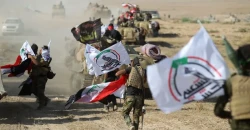
Iraq pushes PMF Law forward despite US warnings of Iranian influence


Shafaq News
As the Iraqi Parliament advances legislation to formalize the Popular Mobilization Forces (PMF) as an independent security institution, tensions with the United States are escalating. Washington warns the bill could entrench Iranian influence and undermine Iraqi sovereignty, while Iraqi officials insist the move is a long-overdue recognition of a key component of the national defense structure.
The proposed law, known informally as the amended PMF Authority Law, is being debated amid a wider struggle over Iraq’s security architecture and regional alignments. US officials view the legislation as a potential shift in the balance of power within Iraq’s armed forces, one that may prioritize loyalty to Tehran-aligned factions over the Iraqi state.
“Legislating this type of law will entrench Iranian influence and terrorist armed groups that undermine Iraq's sovereignty,” US Secretary of State Marc Rubio reportedly told Prime Minister Mohammed Shia al-Sudani in a phone call last Wednesday, according to State Department spokesperson Tammy Bruce.
In response, al-Sudani defended the legislation, describing it as part of a broader security reform initiative passed by parliament. He emphasized that the PMF remains under the authority of the commander-in-chief and operates as an official security formation alongside Iraq’s military and intelligence institutions.
What the New PMF Law Proposes
The legislation—now in its second reading in parliament—would repeal the 2016 law and reconstitute the PMF as a permanent, autonomous military body.
Key provisions include:
-Granting the PMF financial and administrative independence.
-Formalizing it alongside institutions like the National Intelligence and National Security Services.
-Authorizing new formations under the PMF umbrella.
-Giving the PMF commission chief broad authority to implement restructuring and development.
According to the Prime Minister’s office, the draft law aims to improve institutional cohesion and extend benefits to families of fallen fighters.
Iraqi Lawmakers Defend the PMF
Iraqi lawmakers have pushed back against US objections, asserting that the PMF is a state-aligned institution.
“The Popular Mobilization Forces are an Iraqi security institution that receives salaries from the government and takes orders from the Commander-in-Chief, just like other security agencies,” said Ali Ni’ma al-Bandawi, member of the parliamentary Security and Defense Committee, in comments to Shafaq News.
Al-Bandawi emphasized the PMF’s origin following Ayatollah Ali al-Sistani’s 2014 fatwa to defend the country against ISIS, calling it a “sacred ideological force.” He said the law would enhance organizational structure and improve fighters' welfare, not deepen foreign ties.
“American and other foreign interference in drafting laws for the Iraqi Council of Representatives is unacceptable.”
Al-Bandawi also criticized the withdrawal of some parliamentary blocs during the July 16 session, calling it “a misguided step,” and reiterated that the Coordination Framework and State Administration Coalition hold enough votes to pass the law without consensus but prefer to preserve political partnership.
Divisions Inside Parliament
Speaker Mahmoud al-Mashhadani, in a recent televised interview, revealed that the US had sent messages to Iraqi political leaders expressing support for integrating the PMF—not expanding its autonomy.
He warned that the draft law lacked clarity regarding PMF roles and authorities, making it difficult to implement effectively.
This prompted backlash from MPs, who accused him of undermining national consensus and began collecting signatures to demand his removal.
The law passed its second reading during the July 16 parliamentary session, chaired by First Deputy Speaker Mohsen al-Mandalawi, with 172 out of 329 lawmakers in attendance. Some Kurdish and Sunni MPs staged a walkout in protest.
Expert Warnings of Strategic Fallout
Western analysts view the legislation as a turning point.
“The law appears to institutionalize a military structure that is not fully loyal to the Iraqi government,” said Thomas Warrick, senior fellow at the Atlantic Council and former US official at the Department of Homeland Security.
“The United States would prefer to see PMF members integrated into regular army units rather than maintaining autonomous formations.”
Warrick acknowledged that some of the draft law’s provisions are administrative in nature, but argued that others “cause deep concern,” particularly regarding command chains and foreign influence.
He emphasized that the US seeks a unified national military under elected constitutional leaders and remains wary of past cases where PMF leadership showed stronger loyalty to foreign actors than to Iraq's government.
Ahmed Al-Yasiri, head of the Arab-Australian Center for Strategic Studies, echoed those concerns in remarks to Shafaq News, describing the PMF as a “political institution” tied to Iranian regional strategy.
He cited the US strike on PMF leader Abu Mahdi al-Muhandis and Iranian General Qassem Soleimani in 2020 as a reflection of Washington’s view that the PMF threatened the US-designed post-2003 Iraqi security order.
“This law may grant legal cover to groups managed by the Iranian Revolutionary Guard in Iraq,” Al-Yasiri said, warning that passing the bill could severely strain US–Iraq relations and jeopardize American investment and security cooperation, especially in northern regions like Duhok and Erbil, which have seen recent drone attacks blamed on Iran-linked armed forces.
He added that the Al-Sudani government may be seeking to end the current legislative term with a “containment measure” aimed at stabilizing internal dynamics—but risks alienating international partners.
Alternative Perspective: A Shield of Sovereignty
Sabah al-Akili, a Baghdad-based political commentator, described US opposition as “a blatant violation of Iraq’s sovereignty,” accusing Washington of attempting to dismantle regional power structures that challenge Israeli and American interests.
“Any politician who abstains from supporting the PMF law is aligning with foreign agendas,” he told Shafaq News, arguing that neutralizing the PMF would expose Iraq to destabilization and regional fragmentation.
He pointed to developments in Syria’s Suwayda region and Lebanon as part of what he described as a wider campaign to redraw Middle Eastern borders through proxy manipulation and disarmament efforts targeting anti-Western forces.
What Comes Next?
If passed in its current form, the PMF law would deepen the divide between Iraq’s Shiite-dominated political forces and US regional interests. It could trigger renewed scrutiny of US aid programs and military cooperation, especially if American bases or partners in Iraq become targets of groups shielded by the new legal framework.
With Kurdistan Region factions already expressing concern, and Sunni parties signaling defection from the legislative process, the law could also reawaken sectarian and federalist tensions.
At the same time, proponents argue that formalizing the PMF is essential for preserving national unity—and that sidelining it could invite greater chaos and foreign intervention.
Written and edited by Shafaq News staff.