Our night skies are 10% brighter every year, erasing stars from our view
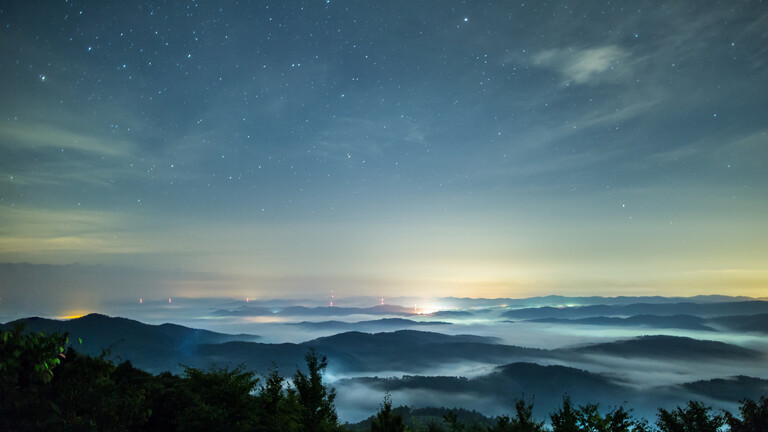


Shafaq News/ The night skies are getting nearly 10 percent brighter each year — “erasing” stars from our view — thanks to increasing levels of light pollution. This is the warning of astronomers following a citizen science project that has collected data on the visibility of prominent constellations for more than a decade. Our changing view, researchers said, is a loss both for scientists — who rely on dark skies to study the cosmos — but also for our “cultural heritage”.
Astronomer Professor Chris Impey of the University of Arizona and Dr Connie Walker of the National Optical-Infrared Astronomy Research Laboratory told the Conversation: “For decades, astronomers have been building telescopes in the darkest places on Earth to avoid light pollution.
“Today, most people live in cities or suburbs that needlessly shine light into the sky at night, dramatically reducing the visibility of stars.
“Satellite data suggests that light pollution over North America and Europe has remained constant or has slightly decreased over the last decade, while increasing in other parts of the world, such as Africa, Asia and South America.
“However, satellites miss the blue light of LEDs, which are commonly used for outdoor lighting — resulting in an underestimate of light pollution.”
A new international project dubbed “Globe at Night” is enlisting members of the public — as “citizen scientists” — to measure how everyday people’s views of the sky are changing.
Prof. Impey and Dr Walker said: “Relying on citizen scientists makes it much easier to take multiple measurements of the night sky over time from many different places.”
Prof. Impey and Dr Walker explained: “The first panel, representing a light-polluted night sky, only shows the few brightest stars.
“Each panel shows progressively more and fainter stars, representing darker and darker skies. The participant then matches what they see in the sky with one of the panels.”
The Globe at Night team launched the reporting page as an online app back in 2011, just as LEDs began to be widely adopted.
In a recently published study, the researchers took a look back at the data collected since, first filtering out potentially unreliable reports such as those collected during twilight, when the Moon was out, or when the sky was obscured by cloud.
This left them still with a whopping 51,000 data points, mostly recorded across Europe and North America.
The team found that, on average, the night sky got 9.6 percent brighter every year — meaning that, for many, the night sky now appears twice as bright as it did just eight years ago.
As Prof. Impey and Dr Walker note: “If this trend continues, a child born today in a place where 250 stars are visible now would only be able to see 100 stars on their 18th birthday.”