The shadow on the slope: Life and death of kolbars on the Iraq-Iran border


Shafaq News
At the edge of Haj Omran area, about 180 kilometers northeast of Erbil toward the Iranian border, the crossing feels less like a checkpoint and more like a gateway to an endless mountain range. Cold air cuts sharply across the slopes as snow settles over old routes, erasing the footprints of those who passed only moments earlier. Beyond an invisible line lies Iran, where a perilous livelihood known as the kolbar quietly unfolds.
Kolbar is a simple Kurdish word with a harsh reality: kol- means back, and -bar means carrier. It describes porters who carry goods across rugged mountain paths, often from impoverished Kurdish areas inside Iran to handover points along the border, or to traders waiting farther inland. For them, the human back replaces the truck, and the mountain becomes a workplace shaped by risk.
The journey can stretch from 10 to 12 hours, draining their body not only through walking, but through constant stopping, detouring, and climbing across steep terrain.
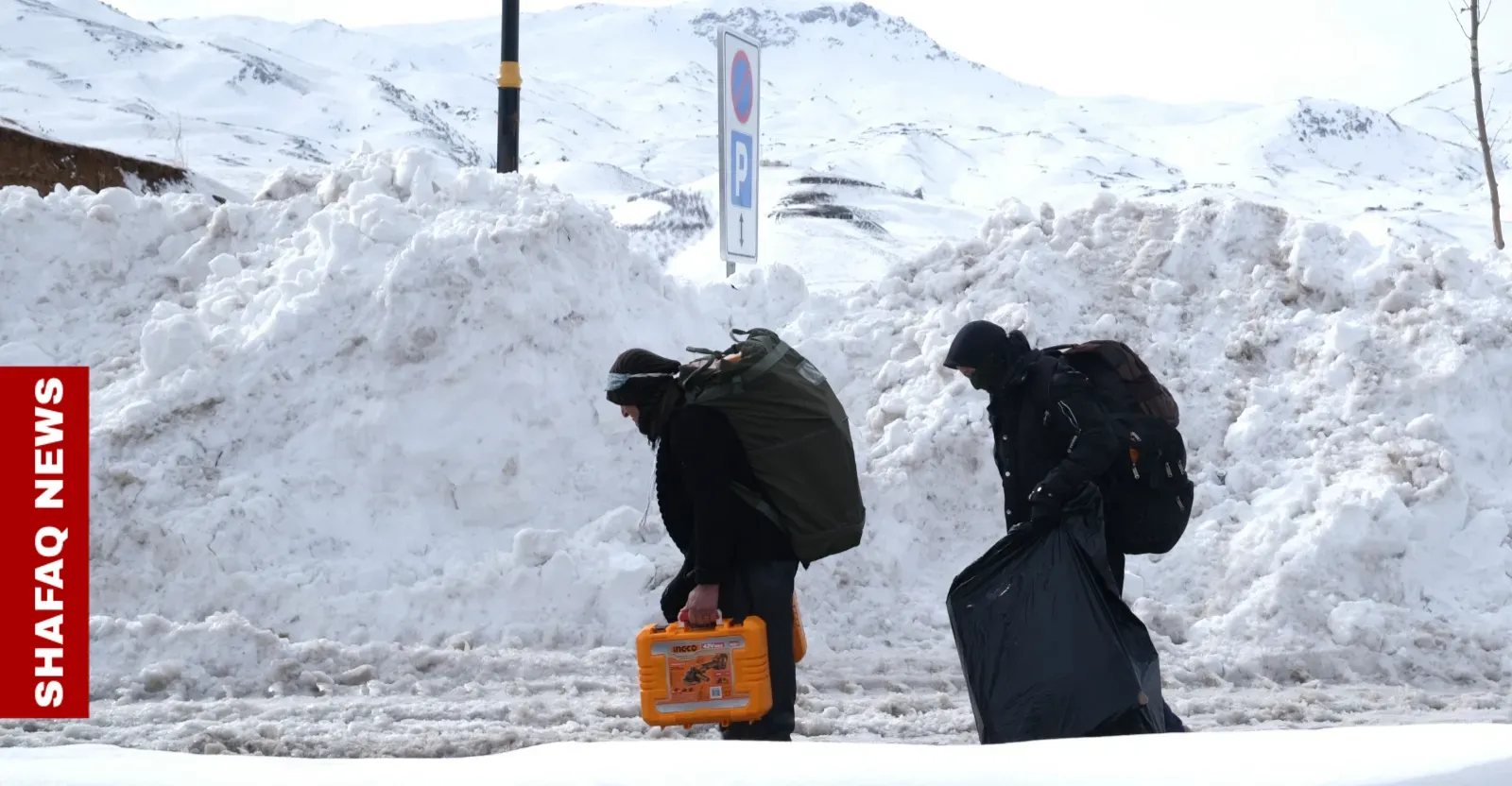
From a distance, kolbars appear as a long, dark line moving slowly across the slope, men and women spaced several meters apart, silent and focused on the ground ahead. This is less a scene of goods transport than of survival: each person carries a compact version of a broken economy, wrapped in cardboard or cloth and tied with an old rope. The story rarely begins at a checkpoint or an earth barrier. It starts farther away, in a cold kitchen in a village, in a family counting what remains in the cupboard, a shopping list that turns into a blank page, and a question that knocks heavily on their mornings: “What will we eat today?”
The stereotype imagines only young men, but the scene captured by Shafaq News shows men in their fifties and women carrying loads along a path that does not distinguish between bodies. In most journeys documented here, kolbars do not carry “large goods” in the conventional sense. Instead, they transport small, fast-selling items —electronics, phone accessories, cigarettes, fabrics— bought in Erbil or other cities in the Kurdistan Region and delivered through mountain passages to traders inside Iran.
Among the silent figures moving across the mountain, Amina, a woman in her sixties from Piranshahr, an Iranian city near the border, stood out. Speaking to Shafaq News, she said economic conditions “show no mercy,” adding that her husband works in the same trade.
Inside Iran, there is usually no single official annual figure for kolbar casualties, and numbers come from independent monitoring organizations and human rights reports that compile scattered incidents into totals. These reports speak of dozens of casualties each year, noting that many cases involve direct gunfire, alongside recurring causes in this terrain such as avalanches, falls from heights, extreme cold, traffic accidents, and landmines left along some routes. As for why they die, there is no single answer. Some deaths are shaped by nature, others by old geography, and others by a bullet, when the border becomes a space where a human being is seen only as a “trespasser.”
Human rights accounts say the line between kolbar and smuggler remains blurred in many incidents, and that those who ultimately pay the price are the ones walking unprotected along the snow line.
Written and edited by Shafaq News staff.