Sharm El-Sheikh Summit: A narrow opening or a carefully staged pause?


Shafaq News – Cairo
Egypt convened an expanded summit in Sharm El-Sheikh on Monday to convert the first phase of the Gaza understandings into a broader political track.
Framed by Egyptian stewardship and US re-engagement under President Donald Trump, the meeting tested whether a high-level coalition could move beyond speeches toward enforceable steps to halt the war and unlock reconstruction. The stakes are immediate for Gaza’s devastated population and wider for a region where any ceasefire will collapse if neighboring fronts reignite.
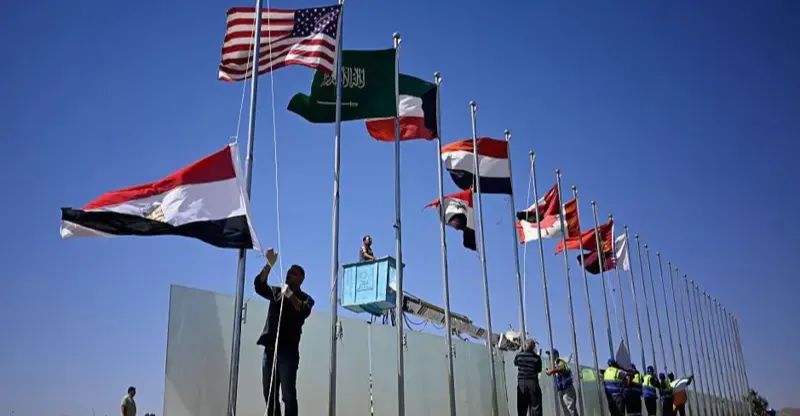
The guest list underscored the ambition. President Abdel Fattah al-Sisi and President Trump co-chaired as Egypt received a dense lineup of leaders and senior officials: Turkish President; Qatar’s Emir; Jordan’s King; Bahrain’s King; Palestinian Authority President; French President; German Chancellor; Italian Prime Minister; Saudi Foreign Minister; British Prime Minister; Canadian Prime Minister; former UK Prime Minister Tony Blair; UN Secretary-General Antonio Guterres; and Arab League Secretary-General Ahmed Aboul Gheit.
Delegations also arrived from Iraq, Indonesia, Pakistan, Greece, Paraguay, and the Netherlands, alongside international institutional representation, including FIFA President Gianni Infantino. Cairo presented the purpose in clear terms: end the war in the Gaza Strip, enhance regional peace efforts, and inaugurate a new phase of security and stability.
Behind the optics lies a sequence that began with Trump’s 20-point plan unveiled on September 29—ceasefire provisions, detainee releases, and Hamas disarmament—followed by US–Egyptian–Qatari mediation between Hamas and Israel. The first-phase implementation, announced in Sharm El-Sheikh on October 9 and activated on Friday, created the political space for today’s broader push. Whether this becomes a pivot depends on two hard variables: legal enforceability and regional containment.
Within Egyptian security circles, retired Lieutenant General Samir Farag rejects the notion that the summit is mere theater. He locates its weight in Washington’s direct management of the file and in a rare alignment between Arab capitals and key European partners.
For Farag, the crucial test is the transition from a ceasefire to verified steps that include the disarmament of Hamas and a full Israeli withdrawal from Gaza—a sequence he deems grueling but not unattainable if US pressure is sustained and Arab–European guarantees are codified. In his reading, Sharm El-Sheikh is where choreography meets coercive diplomacy; one without the other will fail.
From Ramallah, International Relations Scholar Ashraf Akka reads the same moment as a necessary course correction rather than a grand bargain. He argues that Trump’s plan—whatever its branding—now operates inside a regional, not unilateral, logic, with Cairo coordinating more widely than at any time since October 2023.
The point, as he frames it, is simple: “even adversaries have converged on the limits of war, and publics across the region are out of patience with speeches unmoored from deliverables.”
In Akka’s view, the formula must be comprehensive to hold: de-escalation in Gaza cannot survive if the northern front ignites or if strikes continue in Syria and beyond. He places particular emphasis on cross-theater guardrails, including channels that reportedly touch Tehran—an innovation he considers indispensable for durability.
Jordanian researcher Kamal Zaghloul interprets the understandings as the opening stage of a regional de-escalation, not a blueprint for an immediate Palestinian state. He anticipates a pivot toward investment and reconstruction, arguing that stabilization only becomes self-sustaining when energy, water, housing, and employment indicators start to improve—and when financial flows are fenced by transparency and oversight stringent enough to reassure donors and investors alike. In short: “security first, but economics fast.”
Set against these pragmatic readings, Palestinian rights advocate Salah Abdel-Ati, who heads the International Commission to Support Palestinian Rights (HASHD), draws the sharpest red lines. For him, legal enforceability is the fulcrum. “Without binding decisions to stop the killing, lift the blockade, and launch reconstruction, Sharm El-Sheikh risks becoming another diplomatic ceremony with no strategic effect.”
His metric is not atmospherics but obligations and mechanisms: third-party monitoring, penalties for non-compliance, and a calendar that cannot be gamed.
These strands converge around three interlocked challenges that will decide the summit’s legacy. The first is enforcement and sequencing—graduating from truce and detainee exchanges to verifiable demilitarization and withdrawal under a synchronized, enforceable calendar.
The second is Gaza’s governance and security vacuum—crafting an interim arrangement that can maintain order while commanding Palestinian legitimacy, whether via an Arab-led multinational presence, an empowered Palestinian Authority under international supervision, or a hybrid that avoids the pitfalls of external imposition.
The third is regional firebreaks—ensuring that a Gaza-only formula is insulated from escalation along the Lebanon–Israel frontier or spillover into Syria or Iran; here, Egypt’s widened coordination could prove decisive in establishing cross-theater deterrence.
If today’s summit anchors those pillars—monitoring architecture, a staged lifting of the siege, transparent reconstruction finance, and an agreed schedule for withdrawal steps—confidence could scale quickly. That would open the door to a donor framework capable of delivering early wins in power generation, water access, housing, and jobs, turning a paper roadmap into visible gains.
In that scenario, Zaghloul’s economic pivot becomes plausible; the political center in multiple capitals gains breathing room; and Farag’s argument about the utility of sustained US leverage is tested positively on the ground.
If, however, the meeting closes with eloquent communiqués unbacked by law or timelines, Abdel-Ati’s critique will define the verdict: corridors may widen briefly, but the cycle of devastation risks returning with a familiar regularity—truce, flare-up, truce—while the political horizon narrows. That outcome would strengthen maximalists across the region and complicate even the practical cooperation that Cairo and Amman are trying to preserve.
For now, Sharm El-Sheikh offers a narrow opening. Whether it becomes a pivot rather than a pause will be decided not by the breadth of the photo but by the depth of what is signed, verified, and implemented in the days that follow.
Written and edited by Shafaq News staff.