Iraq’s latest land distribution plan faces legacy of unfinished projects


Shafaq News- Baghdad
Iraq’s renewed promise to provide every family with a residential plot has once again brought the country’s chronic housing crisis into sharp focus, reopening questions over whether long-standing pledges can move beyond declarations and into actual delivery.
“We are working to provide every Iraqi family with a residential plot under various development models,” Prime Minister Ali al-Zaidi stated during a cabinet session on June 2, adding that the state is moving toward offering free land nationwide in cooperation with the private sector, oil companies, and the Electricity Ministry to support infrastructure.
The proposal comes as Iraq continues to face a housing shortage estimated at between two million and five million units, with millions of people still living in informal settlements or inadequate housing.
Over recent years, the Ministry of Construction, Housing and Municipalities has rolled out a series of programs, including residential complexes, housing loans, new city projects, serviced land distribution, and approved investment housing schemes, as part of efforts to narrow the gap.
Speaking to Shafaq News, Ministry Spokesperson Istabraq Sabah described the latest initiative as part of a broader government effort to expand housing supply through private-sector partnerships and multiple development models aimed at increasing access to land.
Yet the idea of large-scale land distribution is far from new in Iraq.
Déjà Vu Decrees
After 2003, successive governments relied heavily on land allocation schemes, often directed toward families of victims, political prisoners, public-sector employees, academics, journalists, and welfare recipients.
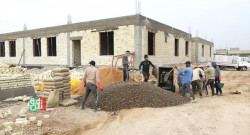
By 2013–2014, the government had launched the “National Housing Initiative,” distributing land and issuing so-called “25-deed” grants through paper-based applications across provinces. Many of those plots, however, lacked basic infrastructure —roads, water, and electricity— while bureaucratic hurdles left large numbers undeveloped.
After 2014, the state shifted toward vertical housing and investment-led residential projects as Iraq entered a period of financial strain linked to the war against ISIS and falling oil revenues.
Read more: Dollar volatility and cash shortages freeze Iraq’s housing and car markets
Lawmakers Talk Back
“All successive governments have announced land distribution projects, but most of them were never implemented,” Mohammed Khalil, member of the parliamentary Services Committee told Shafaq News, estimating Iraq needs around five million housing units to close the deficit.
Lawmakers broadly support new housing initiatives, but MP Uday al-Zamili from Wasit Al-Ajmal Alliance, argued that land alone cannot solve the crisis.
“The housing crisis cannot be solved by granting land alone,” he noted, pointing to the need for full infrastructure planning, including schools and hospitals, before any distribution takes place. Parliament, he added, will maintain oversight of implementation.
Drafts on Dirt
In 2019, amid the Tishreen (October) protests, the government led by Adel Abdul-Mahdi issued Decision 70, promising serviced residential plots of 200–300 square meters, with additional support for low-income groups.
The project collapsed after the government’s resignation months later, before infrastructure works or final land transfers were completed.
A different approach followed in 2021 under Prime Minister Mustafa al-Kadhimi, who launched the “Dari” platform —a digital system designed to distribute land at scale. It allocated around 500,000 plots and issued about 186,000 preliminary deeds across Baghdad, Basra, Karbala, Al-Anbar, and other provinces.
The initiative later drew criticism after many of the designated plots were found outside urban master plans or located in remote desert areas lacking water, electricity, and roads.
Beyond policy shifts and technical limitations, analysts point to a growing credibility gap between citizens and the state.
Political analyst Adel al-Ghariri observed that public confidence in housing promises has steadily eroded after years of unfulfilled commitments across housing, services, and employment sectors.
Any new announcement, he added, is likely to be met with caution unless backed by visible progress on the ground.
Meanwhile, property prices have surged beyond the reach of many households, including low- and middle-income families, with some areas reaching levels comparable to or higher than neighboring countries despite investment incentives.
For many Iraqis, the pattern is all too familiar: ambitious plans announced with great promise, only to face delays, limited implementation, or fade before reaching the people they were meant to serve. The gap between official pledges and everyday reality therefore remains one of Iraq’s most enduring challenges.
Read more: Crushed dreams, rising demand: Iraq’s deepening housing crisis