Iraq's Coordination Framework is weakening, but no rival is ready to replace it


Shafaq News- Baghdad
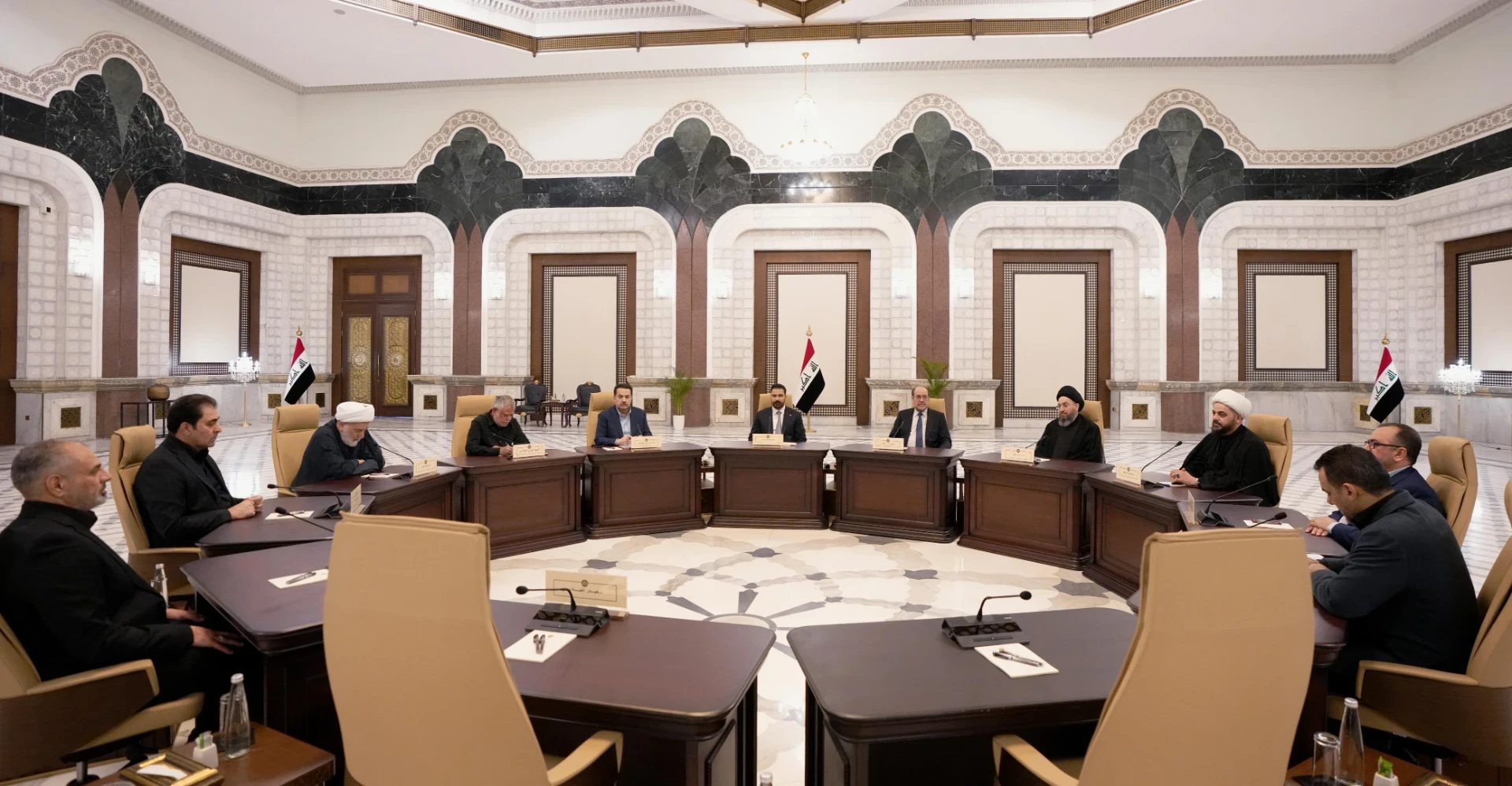
Iraq's Coordination Framework, the alliance of Shiite parties that has run the country since 2022, is weaker today than at any point since it was assembled. It is also, for now, the only game in Baghdad, and that pairing —a governing bloc losing its grip while facing no one able to take its place— explains more about where Iraqi politics is heading than any single quarrel inside it.
The Framework was not designed to be a party, or even a permanent coalition. It formed in 2021 for one purpose: to prevent Muqtada al-Sadr, the populist Shiite cleric whose list had won the most seats, from building a majority government that would have pushed the Iran-aligned parties out of power. Isam al-Faili, a professor of political science at Baghdad's Mustansiriyah University, describes an alliance that carried an unclear label from the day it was born and has only ever been a gathering of forces that agree on very little.
Read more: Explainer: Iraq’s Coordination Framework and Its Rise to Power
Hostility to al-Sadr supplied the glue. When he walked away, the glue began to dry. How this alliance holds, or frays, is not a domestic curiosity: it governs a major oil producer, sets the terms of Baghdad's dealings with both Washington and Tehran, and now holds the fate of the armed groups through which Iran projects power across the region.
Al-Sadr's exit is also the reason the Framework looks so commanding today. He boycotted the November 2025 election outright, and in his absence the Framework's constituent parties returned to the field and claimed roughly 175 of parliament's 329 seats, well above the 130 or so they controlled after the Sadrists quit parliament in 2022. They reached that total by running apart rather than together —Nouri al-Maliki's State of Law, Qais al-Khazali's Sadiqoon, Ammar al-Hakim's National State Forces, and Mohammed Shia al-Sudani's Reconstruction and Development each contested separately and allied with others.
Analysts have labeled the tactic-controlled fragmentation: split to harvest the maximum number of seats under an election law the Framework itself redrew to reward large lists, then regroup afterward to name the prime minister and parcel out the ministries. It worked cleanly, and in working it exposed the trait that now defines the alliance. The Framework can coordinate with precision when the prize is seats, and hardly at all once the question becomes what to do with them.
Read more: Exclusive: Coordination Framework split into three factions over armed groups
What holds it together has narrowed to a single shared interest: keeping hold of the state and everything attached to it —the offices, budgets, and patronage that have organized Iraqi government since the US invasion in 2003. The discipline this generates is real and easy to underrate. Framework leaders do not turn on one another in public, and when the bloc issues a collective position, none of them steps out to disown it. That the parties ran as separate lists and then reassembled without a public rupture is itself evidence of coordination, not decay. The unity is genuine at the level of the statement, even when it dissolves the moment anyone tries to act on it.
Nowhere is the discipline clearer than in how the Framework picks prime ministers, and nowhere is its dysfunction clearer either. Installing al-Sudani in 2022 took just over a year, the longest government-formation deadlock since 2003. Once in office, he tried to grow a base of his own, and by November 2025 his list had finished first, yet the Framework still refused him a second term, with corruption files trailing him as he was eased aside.
Read more: The Shiite Coordination Framework: Can govern Iraq, but cannot agree on a prime minister
Haitham Numan, a professor of political science at Britain's University of Exeter, reads that arc as a lesson the bloc teaches its own premiers: reach for independence and you become a target.
The search for al-Sudani's successor then stalled for five months. It broke only when US President Donald Trump moved against al-Maliki's bid to return, threatening to cut security cooperation and freezing dollar transfers to Baghdad until the Framework dropped him. The compromise that emerged was Ali al-Zaidi, a businessman with no party, no faction, and no political record, chosen because he alarmed no one.
Al-Zaidi was sworn in on May 14 with only 14 of 23 ministers approved; the interior and defense portfolios, the core of the security establishment, sat empty amid disputes the bloc could not settle. Al-Faili notes that even al-Zaidi was not a settled choice until the final moment. The relationship between the government and its makers is one of mutual dependence rather than separation; the Framework keeps producing weak premiers because a weak premier is the only kind all of its members will tolerate.
There is one dispute this method cannot swallow, and it is the one now pressing hardest on the alliance. Several Framework members are not only political parties; they also command weapons. Al-Amiri's Badr Organization is among the largest factions inside the Popular Mobilization Forces, the state-funded umbrella of mostly Iran-aligned armed groups; al-Khazali's Asaib Ahl al-Haq fields both lawmakers and fighters; the Hoqooq movement is widely understood as the political face of Kataib Hezbollah. So when the Framework authorized al-Zaidi in early June to bring all weapons under state control, presenting the step as a sovereign national decision, some of the figures signing off were being asked to take apart the very source of their leverage.
Al-Faili observes that arms are handled case by case rather than by any collective ruling of the bloc, and events bore him out within days. Asaib Ahl al-Haq and Kataib al-Imam Ali announced they would place their brigades under state authority; Kataib Hezbollah and Harakat al-Nujaba refused, with Kataib Hezbollah professing support while insisting on keeping its drones and missiles. The same fault line runs through the half-empty cabinet, where the security ministries remain contested precisely because they decide who commands the men with guns.
Driving all of it is outside pressure, Washington's envoy Tom Barrack, the frozen dollar transfers, and a September 30 deadline after which unlicensed weapons are to face legal action. The word both camps reach for is sovereignty, though they mean opposite things by it: for the state-first parties it describes a government monopoly on force, and for the resistance factions it describes defiance of American power.
The timing sharpens everything. A year after the war that left Iran badly weakened and stripped of its allies in Syria and Lebanon, Tehran now leans on Iraq as its most dependable partner, exactly as Baghdad is being pushed to disarm the groups that anchor that relationship.
Abbas Ghadir al-Jubouri, a researcher on Iraqi political affairs, argues that what looks like erosion is political repositioning rather than retreat, and that the Framework remains the government's sponsor with al-Zaidi its chosen product. On the matter of form, he is right; nothing on the horizon is poised to unseat the alliance. Numan's reading runs deeper and darker: the Framework stands at its weakest and still rules, held up less by its own strength than by the absence of any figure able to unify the Shiite house, offering what he calls protocol cover in place of real political cover. Both descriptions hold at once. The Framework is not going to dissolve, and it is not going to be replaced. What is draining out of it is substance.
The September 30 deadline puts to the alliance the question its whole design was meant to avoid. A coalition assembled to share power can absorb almost any disagreement that money and offices are able to settle. Whether it can survive being asked to surrender the weapons that make some of its members powerful in the first place is the test it has spent four years avoiding, and the one it can no longer postpone.
Written and edited by Shafaq News staff.