Asaib Ahl Al-Haq joins Iraq's cabinet as hardliners reject disarmament deadline
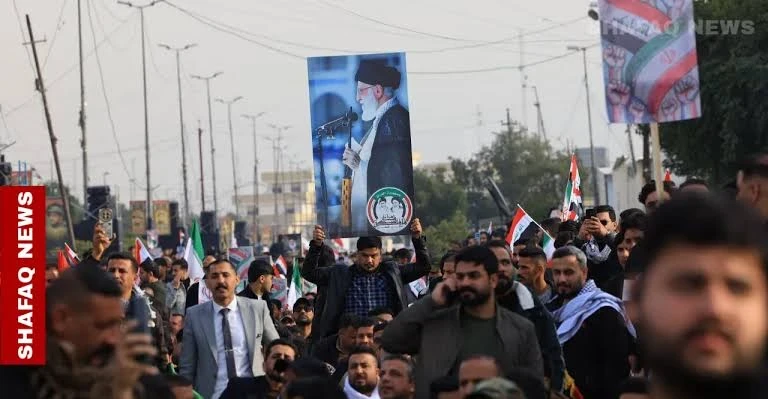


Shafaq News
Iraq's parliament appointed Laith al-Khazali, a senior leader of the Iran-aligned armed faction Asaib Ahl Al-Haq, as deputy prime minister on October 15, three weeks into a government plan to bring all faction weapons under state control by June 30, 2027. The appointment illustrates what appears to be a central feature of Prime Minister Ali al-Zaidi's approach: factions that cooperate with the state's weapons-control plan gain greater room inside formal institutions, while the most heavily armed groups continue to reject deadlines they did not negotiate.
The factions are where Iraq is most exposed to the confrontation between the United States and Iran. Most of them run brigades inside the Popular Mobilization Forces (PMF), a state-funded umbrella of mostly Shiite armed groups formed in 2014 to fight ISIS, while keeping their own chains of command. They are also a major force in parliament. Their political wings and allies hold roughly 60 to 70 of the chamber's 329 seats, according to common estimates, and up to 97 when broader faction-linked forces are counted.
Since the conflict between Iran on one side and the United States and Israel on the other began in February, statements issued under the banner of the Islamic Resistance in Iraq (IRI), an umbrella name used by the most hardline factions, have claimed hundreds of operations against US sites in Iraq and the region.
Individual factions have generally not claimed attacks in their own names. Washington and the Kurdistan Regional Government have accused Iraqi factions of attacks on US forces and on the Kurdistan Region, while Iran's Revolutionary Guard has claimed some strikes on Iranian Kurdish opposition camps there. US and Israeli strikes have also hit faction positions on Iraqi soil.
For years, the factions tied the future of their weapons to the presence of foreign troops. That argument lost its anchor on September 30, when the US-led Coalition ended its military mission in Iraq. The government had first set the same date as its disarmament deadline, then separated the two. Al-Zaidi's staged plan opened on October 1 with a 90-day de-escalation period, during which the factions refrain from attacks and receive guarantees that US forces will not strike them. Weapons handovers follow, to be completed by the end of June.
The Coordination Framework, the alliance of Shiite parties that nominated al-Zaidi and holds a parliamentary majority, endorsed the timetable at an emergency meeting called by the prime minister on October 2. The alliance includes the political wings of several armed factions, and its statement welcomed "the armed factions' commitment to the agreement."
Three weeks in, the truce has held. No attacks on US sites or facilities have been reported since October 1, and no Iraqi faction has entered the wider regional conflict. Kataib Hezbollah, the most powerful of the hardline groups, announced on October 1 that it would halt military operations in Iraq following the US withdrawal, and Sabah al-Numan, spokesman for the commander-in-chief of the armed forces, said the factions had pledged to respect the 90-day window.
Whether this reflects the plan's success is less clear. The period has also coincided with a pause in military escalation across the region, which has given the factions little reason to act.
Read more: Iraq's second US troop withdrawal shifts the test to armed factions
Inside The State
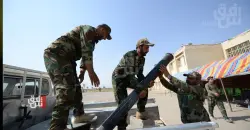
Al-Khazali's path into government shows how the plan works in practice. He is the brother of Asaib Ahl Al-Haq's leader, Qais al-Khazali, and the group is designated by the United States as a terrorist organization over its ties to Iran's Revolutionary Guard. The group sought the deputy premiership in May and pledged in June to cut its ties with its three PMF brigades. In August, it handed equipment from two of them to a committee of the interior and defense ministries, the National Security Advisory and the PMF at a base in Yusufiyah, south of Baghdad.
Sources told Shafaq News at the time that the transfer included fewer than ten drones, none carrying munitions, and no missiles. The committee's benchmark is the surrender of missiles with a range of 300 kilometers or more.
Washington had objected to al-Khazali's nomination, as initially had former prime minister Nouri al-Maliki's State of Law coalition, a senior partner in the Coordination Framework. According to Shafaq News sources, al-Zaidi secured tacit US acceptance during his September visit in exchange for commitments on disarmament.
US sanctions on al-Khazali remain in force, and Congressman Joe Wilson condemned the appointment on the day of the vote. In a report published on October 19, the Middle East Forum, a US think tank, argued that the American bet on al-Zaidi had failed once he agreed to bring Iran-aligned forces into the machinery of government.
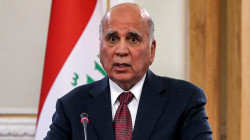
The government's public account of progress remains incomplete. Foreign Minister Fuad Hussein told reporters in Washington, including a Shafaq News correspondent, that three of the seven factions negotiating with the government had accepted the plan. Al-Zaidi later put the figure higher, saying five factions had agreed and three had already handed over weapons. He did not name them, say what had been surrendered, or say whether any transfer met the missile benchmark.
Asaib Ahl Al-Haq, Kataib al-Imam Ali and Saraya al-Salam, the armed wing that Shiite cleric Muqtada al-Sadr separated from his Patriotic Shiite Movement earlier this year, have each announced steps toward integration.
Pressure is also building inside the ruling coalition. On October 6, a political source told Shafaq News that al-Zaidi had warned Coordination Framework parties with armed wings against failing to meet their commitments. A week later, at the Middle East Research Institute forum in Erbil, al-Numan said the Coalition's withdrawal "had removed all pretexts" for refusing to place weapons under state control.
The Holdouts
On the day it announced the pause, Kataib Hezbollah denied reaching any disarmament understanding with the government, saying its weapons "will remain as a trust in the hands of our mujahideen." Jaafar Al-Husseini, the group's spokesperson, said the "resistance" was not bound by any timetable issued by a government or political body. The factions' price, he said, is "full sovereignty": the departure of every form of foreign military presence.
Harakat Hezbollah al-Nujaba now rejects any American presence under any label, including military advisers and private security companies. Kataib Hezbollah, whose political wing, the Hoqooq Movement, holds six parliamentary seats, has gone further. On September 28, its security chief, Abu Mujahid al-Assafi, threatened to work to bring down the government.
The group's secretary-general, Abu Hussein Al-Hamidawi, set out his own model of the state on the day the last Coalition troops left. Having "resistance" forces alongside the official security services was nothing to be sensitive about, he said. "Many countries in the world have more than one army."
Even the refusals are formally conditional. Faleh al-Khazali, head of the Montasiroun bloc, the political wing of Kataib Sayyid al-Shuhada, told Shafaq News that four factions, Kataib Hezbollah, Kataib Sayyid al-Shuhada, al-Nujaba and Harakat Ansar Allah al-Awfiya, were prepared to place their weapons under state control if their conditions were met, including the departure of foreign forces and foreign armed groups from Iraq.
Kataib Sayyid al-Shuhada declared its adherence to the plan on October 1, provided the other side honors its obligations, although its spokesman, Kazem al-Fartousi, told Shafaq News that bringing weapons under state control cannot be separated from achieving full sovereignty.
Harakat Ansar Allah al-Awfiya made a similar pledge. Ali al-Fatlawi, one of its leaders, told Shafaq News that the factions would hand over their weapons voluntarily if Washington respects Iraqi sovereignty, and could not do so if it does not. "The resistance is a reaction, not an action," he said.
Jawad al-Dahlaki, a security expert, told Shafaq News that every faction had privately accepted the 90-day window and that the public refusals were aimed at a domestic audience. The record so far supports him only in part: the halt in operations has held, but the hardline arsenals remain in place.
The factions' conditions also reach beyond Washington. They demanded the withdrawal of Turkish troops from northern Iraq, where Ankara has kept military positions for years in its campaign against the Kurdistan Workers' Party (PKK), the Kurdish militant group that has fought the Turkish state since 1984 and is now in a peace process. That withdrawal has so far been partial. On September 23, al-Zaidi and Turkish President Recep Tayyip Erdogan agreed that Turkish forces would gradually hand the Bashiqa-Zilkan camp near Mosul to Baghdad, an arrangement limited to that base. Ankara has tied anything broader to the PKK.
Turkish Foreign Minister Hakan Fidan linked further reductions to Baghdad's plan to disarm the group and its affiliates in Sinjar, and on October 20 Defense Minister Yasar Guler said Turkiye would keep its forces in Iraq, estimated at 800 to 1,000 troops, until its border security is fully guaranteed. The PKK said on October 8 that it had evacuated four positions in Iraq's Metina area. The factions' demand that Turkish forces leave before they disarm now meets Ankara's demand that Baghdad disarm the PKK before Turkish forces leave.
Iran's position remains a decisive variable. Sources told Shafaq News in August that Esmail Qaani, commander of Iran's Quds Force, urged the factions not to disarm for now, while warning them against armed confrontation with the government.
US analysts disagree on what Tehran wants from them next. Ross Harrison, a senior fellow at the Middle East Institute and author of Decoding Iran's Foreign Policy: Strategic Interests, Power and Influence, told Shafaq News that Iran now intends to project deterrence through its own military capabilities rather than relying mainly on regional allies.
Jason Campbell, also a senior fellow at the Middle East Institute, reads it the other way. With Lebanon's Hezbollah weakened, he said, Tehran is leaning more heavily on Yemen's Houthis and the Iraqi factions to preserve its influence. In this view, Iran has little reason to let its strongest Iraqi allies disarm.
Read more: How Iran’s ‘unity of fronts’ strategy is changing across the Middle East
The Road To June
Much of the substance will be settled in the legislation governing the PMF. On September 30, the cabinet approved a PMF bill and sent it to parliament. Abu Turab al-Tamimi, a lawmaker from the Badr Organization, one of the oldest Iran-aligned groups, with both a parliamentary bloc and brigades within the PMF, told Shafaq News that talks run on two tracks: laws on the PMF's structure and its members' service, and a "sovereignty" proposal under which factions would transfer their arsenals into the PMF rather than surrender them.
Senior Coordination Framework leaders have preferred to describe the process as "regulating" weapons rather than disarmament, language intended to ease faction resistance. Critics say the formula would legalize the weapons; supporters say it would bring them under state command. Abdul Qader al-Nayel, an Iraqi political researcher, warned that the bill could entrench a dual structure in security decision-making, the arrangement Al-Hamidawi describes as normal.
The decisive date is therefore not June 2027 but the end of the truce, around the turn of the year. Until recently, it faced two risks: a US strike or a faction attack. A third has since emerged. Concern over renewed US-Iran fighting is growing, and on October 20, Baghdad ordered the Al-Sheeb crossing with Iran closed from the following morning until further notice, officially citing technical reasons.
Campbell described Washington's wider demand to seal the border as unrealistic. Iraq serves as an economic outlet for Iran, he said, and closing the frontier would require a complex military effort in areas where Iran-aligned factions hold influence on the ground. The border and the disarmament plan now depend on the same actors. If war resumes, the factions will not need to break the truce themselves to renew their case for keeping their weapons.
Written and edited by Shafaq News staff.