Iraq’s Development Road cuts Europe trade by 11 days


Shafaq News- Baghdad
Iraq's Development Road project is expected to shorten cargo transit times to Europe by 11 days compared with the Suez Canal route, as Baghdad advances plans for a 1,200-kilometer transport corridor connecting the Grand Faw Port with Turkiye and European markets, Ali Al-Khalidi, the Transport Ministry spokesperson, told Shafaq News on Saturday.
Al-Khalidi outlined the project's main routes and technical specifications, describing it as an alternative trade corridor between East and West that would also create investment opportunities across Iraq.
Beginning at the Grand Faw Port in Basra, the railway will pass through Nasiriyah, Al-Muthanna, and Al-Diwaniyah before reaching Najaf and Karbala. It will then bypass Baghdad, continuing through Samarra, Tikrit, and Mosul before reaching Fish Khabur and crossing into Turkiye.
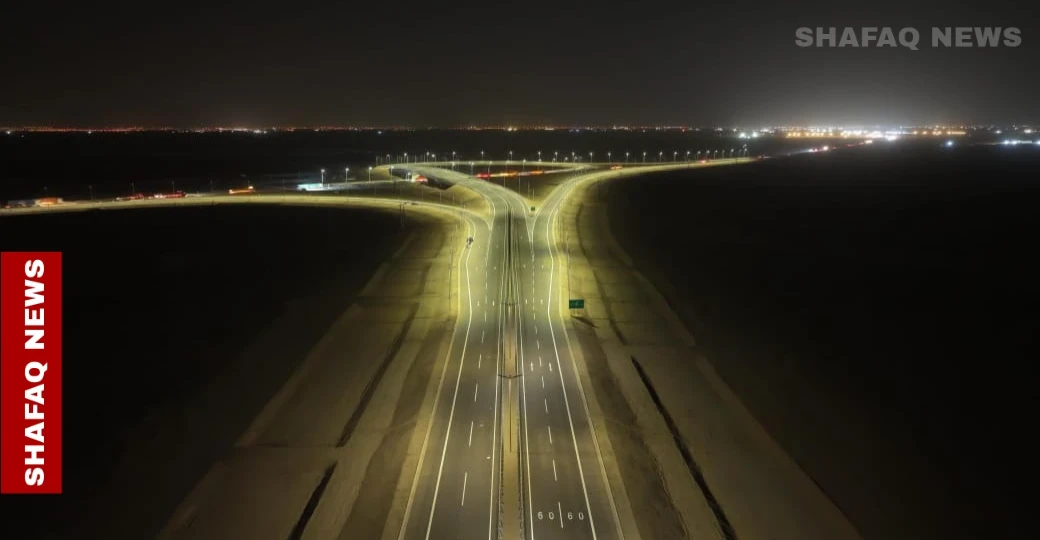
The highway will follow a separate alignment, extending from the immersed tunnel area and Umm Qasr toward western Al-Muthanna province. Both routes, according to Al-Khalidi, are designed to bypass city centers and run through open areas, limiting disruption to residential communities while providing space for industrial zones, logistics facilities, oil projects, and housing developments.
The railway will also connect the Grand Faw Port to the Turkish border and incorporate the rehabilitation and modernization of Iraq's existing rail network. Under the technical plans, passenger trains will reach speeds of up to 300 kilometers per hour, while freight trains will operate at a maximum of 140 kilometers per hour.
According to Al-Khalidi, the network will include 15 passenger stations, 12 freight stations, and six multimodal transport hubs, as well as 24 rest and service stations and six operational complexes equipped with emergency response, traffic management, firefighting, and maintenance facilities.
The wider project will also include dry ports, freight maintenance centers, and three large residential complexes near transport hubs in Basra, Baghdad, and Mosul.
Design work is nearing completion, with the railway route more than 95% complete and the highway exceeding 92%, Al-Khalidi said. Preliminary and detailed designs are expected to be finalized by the end of 2026.
The first phase, scheduled for completion in 2028, will establish the connection with Turkiye, while the two subsequent phases will expand the corridor and increase its operating capacity. Turkish interest in the project reflects its potential to strengthen trade links between Asia and Europe, he added.
According to figures provided by Al-Khalidi, cargo shipments along the Development Road would take around 25 days, compared with 36 days through the Suez Canal and 46 days via the Cape of Good Hope.
Read more: Rebuilding Basra’s maritime power: Is Al-Faw Port the game changer for Iraq?
Regional Partnerships and Investment
Alongside its infrastructure plans, Iraq is seeking to broaden regional support for the project through cooperation with Turkiye, Qatar, and the United Arab Emirates. The three countries joined Iraq in signing a quadrilateral agreement in April 2024, under the auspices of then-Prime Minister Mohammed Shia Al-Sudani and Turkish President Recep Tayyip Erdogan.
Al-Khalidi said reviving cooperation through the four-country council would help advance the project and attract additional partners. A proposal to include Saudi Arabia in the council is also under consideration.
The project has an estimated investment cost of $17 billion, comprising $6.5 billion for the highway and $10.5 billion for the electric railway. Its three phases have target completion dates of 2028, 2033, and 2050.
Intended to strengthen Iraq's position as a regional trade hub, diversify its economy, and expand investment and employment opportunities, Baghdad previously estimated that the first phase would generate around 100,000 jobs, with the figure potentially reaching one million upon completion of the entire project.
Read more: Iraq’s Development Road: Geopolitics, rentierism, and broader connectivity