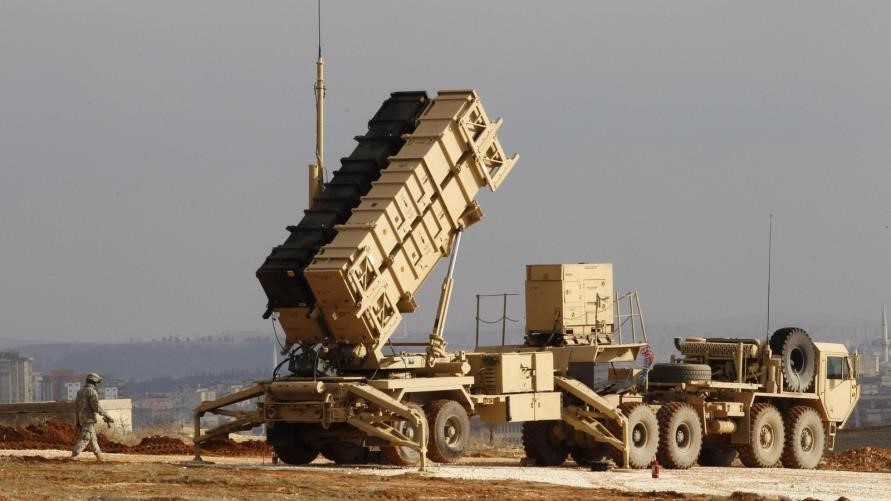
Shafaq News / The Biden administration is sharply reducing the number of U.S. antimissile systems in the Middle East in a major realignment of its military footprint there as it focuses the armed services on challenges from China and Russia, administration officials said.
The Pentagon is pulling approximately eight Patriot antimissile batteries from countries including Iraq, Kuwait, Jordan and Saudi Arabia, according to officials. Another antimissile system known as a Terminal High Altitude Area Defense, or Thaad system, is being withdrawn from Saudi Arabia, and jet fighter squadrons assigned to the region are being reduced, those officials said.
The redeployment includes hundreds of troops who are members of units that operate or support those systems. The move comes as the military plans a complete withdrawal from Afghanistan by this summer and after the U.S. last fall cut its force posture in Iraq by half—or 2,500 troops—because it said Iraqi forces could secure the country.
The latest reductions, which haven't been previously reported, began earlier this month, following a June 2 call in which Defense Secretary Lloyd Austin informed Saudi Crown Prince Mohammed bin Salman of the changes, officials said. Most of the military hardware being removed is coming from Saudi Arabia, officials said.
The U.S. moved Patriot antimissile systems to Iraq after Iran in January 2020 fired missiles at the Al Asad base in western Iraq, where U.S. troops are stationed. The Iranian attack was a response to a U.S. drone attack that killed Qassem Soleimani, the Iranian military leader.
The Pentagon began sending Patriot antimissile batteries and the Thaad system to Saudi Arabia after a Saudi oil facility was attacked by Iranian drones in September 2019.
The decision to remove some of the defensive systems reflects a Pentagon view that the risk of escalating hostilities between the U.S. and Iran has diminished as the Biden administration pursues nuclear talks with Tehran and has signaled its intention to ease sanctions if the 2015 nuclear deal is restored.
However, Iranian-backed militias, equipped with drones, still present a threat to U.S. and coalition forces in Iraq, and have been accused in a series of drone attacks in recent weeks in Baghdad and northern Iraq. There also have been more than 100 attacks against Saudi Arabia this year, including at least one that hit a royal court complex.
Systems such as the Patriot don’t guard against drone attacks, but are seen as helping to protect American forces against an ever-present ballistic missile threat. Iran has denied it is behind the recent attacks.
A senior defense official said the equipment withdrawals amount to a return to a more traditional level of defense for the region. Under former President Donald Trump, the U.S. actively deployed defensive systems as well as troops, jet fighter squadrons and naval warships to support its maximum pressure campaign against Iran.
The hardware hasn’t deterred Iran or its proxies from destabilizing actions, officials said. Saudi Arabia also has improved its defensive capabilities, intercepting most rocket attacks on its own, they said.
In addition, the U.S. antimissile systems have been heavily used in the last several years and need to be returned to the U.S. for maintenance and refurbishment, officials said.
“What you’re seeing is a realignment of resources with strategic priorities,” said a senior defense official, who stressed that the resources coming out of the region are only a portion of what the U.S. deployed there.
A White House official said that some personnel and equipment from Afghanistan are being relocated to the Middle East to respond to some of the threats in the region.
U.S. Central Command, which oversees U.S. forces in the Middle East and Afghanistan, declined to comment on the changes. Officials representing the countries affected didn’t immediately respond to requests for comment.
Former officials who took part in decisions to increase U.S. defenses in the region said that circumstances have since changed, both in the Middle East and beyond.
“To the extent that Saudi Arabia has improved its own defensive capabilities, and the United States seeks to resolve tensions with Iran using diplomatic tools, this decision makes sense,” said Kathryn Wheelbarger, former acting assistant secretary of defense during the Trump administration who is now a fellow at the Washington Institute for Near East Policy.
She added: “Is there some increased risk? Yes. But it’s about managing the risk, not eliminating the risk.”
A much-anticipated Biden administration review of its military force posture is due next month, but the Pentagon already is moving chess pieces around a global board to reinforce its goal of countering China and Russia.
The Patriot systems, which have been in high demand for years, aren’t necessarily being moved to the Indo-Pacific region, however. But sending them back to the U.S. for maintenance and freeing up personnel who operate and guard them allows the military to increase its focus elsewhere.
The move marks the second time this year the U.S. has removed Patriot antimissile batteries from the Middle East. This spring, the U.S. military removed at least three Patriot missiles from the Saudi Arabia and had considered taking out a Thaad.
Officials said the withdrawal could be seen by Russia and China, who are expanding their military and economic influence in the Middle East, as an opportunity to increase their aims.
But defense officials point to a mosaic of U.S. involvement in the region, including foreign military sales, security cooperation, joint military exercises and maintaining U.S. ground troops.
“Yes, Russia and China are going to attempt to utilize adjustments in posture to message that the United States cannot be relied upon,” a defense official said. “The reality is that none of them are going to replace the United States and what we provide.”